40,000+ critical vulnerabilities
Confirmed and reported across 1,000+ customers in 30+ countries.
Penetration testing as a service
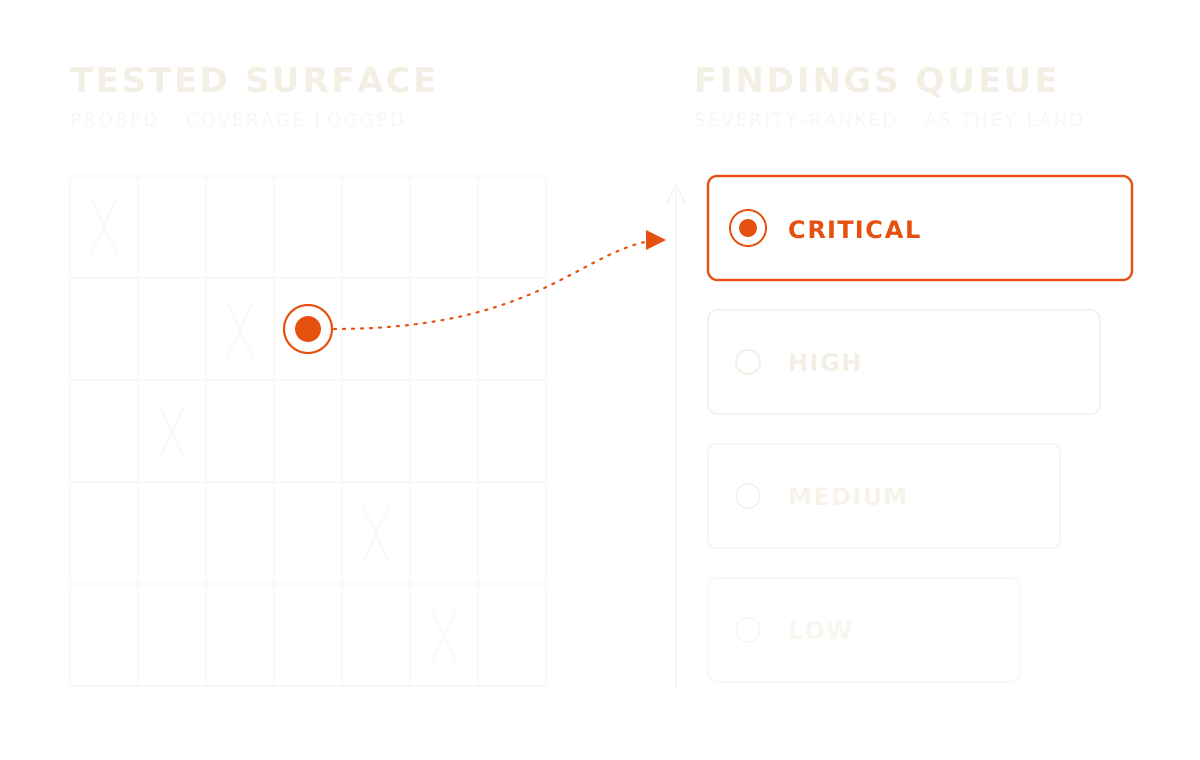
Vulnerabilities surface the moment a researcher confirms them, ranked by severity. No 400-page export weeks after the code changed.
Submit a fix, schedule verification, and the report updates. No re-scoping, no second procurement cycle.
CREST-accredited testers who publish CVEs run the engagement. The platform holds the evidence.
Trusted by security and product teams in Fintech, SaaS & Education, Enterprise & Telecom, Security & Critical Infrastructure




Proof, not promises
Run by the team behind SecureLayer7's CVE disclosures. You see the testing work and the evidence, not just a finding count.
40,000+ critical vulnerabilities
Confirmed and reported across 1,000+ customers in 30+ countries.
Caught before the attacker
Critical issues found, fixed, and re-tested before they were exploitable, with reporting your board and auditors can defend.
CVSS 9.9 zero-day
Full system compromise found and disclosed in production software by the team that runs your engagement.
Re-test on demand
Submit a fix, the testers verify it, and the report updates. No new statement of work.
Who this is for
A one-off project pentest gives you
One app, tested once, ahead of a single audit.
A snapshot that is true the day it is delivered.
A static PDF that ages the next time you deploy.
Choose the platform if
You ship to production every sprint, so a Q1 test never covers what went live in Q3.
Auditors keep asking for a current report, not last year's.
Findings die in a PDF instead of reaching the developer who owns the code.
You re-buy and re-scope a pentest every time a fix needs verifying.
From scope to verified fix
Scope, test, triage, and re-test in one place. No email threads, no PDF handoff, no waiting weeks for the report.
Define targets and rules of engagement in the platform. A SecureLayer7 lead confirms scope and start date. Days, not a procurement cycle, and no new loop for every re-test.
CREST-accredited researchers run the engagement: business-logic abuse, chained exploits, and authenticated attack paths. Tooling maps the surface so testers spend their time where judgment is the only thing that finds the flaw.
Each confirmed vulnerability arrives as a step-by-step attack narrative: the request, the response, a recorded proof-of-exploit, and developer-ready remediation. Push to Jira, ServiceNow, or Slack.
Submit the fix, schedule verification, and the report and attestation letter update. No new SOW.
What gets tested —
Engagements follow the attack the way an intruder would: web to API to identity to internal, not one isolated checklist at a time.
Authn/z bypass, business-logic abuse, injection, and SSRF chained to internal access.
BOLA, BFLA, mass assignment, and broken auth across REST, GraphQL, and gRPC.
Post-foothold lateral movement, privilege escalation, and domain compromise.
Over-privileged roles, token replay, federation tampering, and metadata-service pivots.
Insecure storage, certificate-pinning bypass, hardcoded secrets, and client-side API abuse.
Code-informed testing where you grant access. A faster path to the flaw that matters.
Re-test, in the platform
No email thread, no new statement of work. Mark a finding ready, the tester re-verifies it, and the report updates in place.
Inside the platform
What you get behind one login, on every engagement.
Vulnerabilities appear the moment a tester confirms them, ranked by severity. You also see the attack surface the testers covered, including where they found nothing exploitable.
On record
CREST accredits SecureLayer7 and its testers. CERT-In, SOC 2 Type II, and ISO/IEC 27001 govern how your scope, access, and engagement record are handled.



Recognized by
The pentest market gets surveyed every quarter. We have shown up in the reports our buyers read before they cut a PO.
 Peer Insights, Application Security Testing
 Radar, Penetration Testing as a Service
From the teams using it
01 / 04
They actually found things that mattered, and the report was clear enough for our developers to act on.
Dan Bailey· Sr. Principal Application Security Architect at Oratorio Partners
Stop re-buying the same pentest
A short scoping call sets up the engagement. After that, testing keeps pace with what you ship.
Before you buy
Delivery, coverage, and how this differs from a one-off pentest. Not here? Ask a security expert.
Beyond the platform
BugDazz PTaaS runs continuous application and API testing. When an engagement needs network, cloud, red-team, or specialist depth, the same CREST-accredited team covers it, under one relationship.
Objective-led adversary emulation across web, identity, endpoint, and physical seams. Initial access, privilege escalation, persistence, and proven domain takeover.
Prompt injection chains, tool-use abuse, training-data exfiltration, output-handling flaws, and agent boundary failures on production LLM deployments.
Reentrancy, access-control and oracle-manipulation flaws, unchecked external calls, and economic-logic abuse across EVM and multi-chain contracts.
Authenticated business-logic abuse, IDOR chains, SSRF to cloud metadata, deserialization, and the full OWASP class on web, mobile, and thick-client targets.
IAM privilege escalation paths, exposed metadata services, misconfigured S3 and RBAC, lateral movement across accounts, and Kubernetes break-out scenarios.
Internal and external network attack paths, Active Directory abuse, segmentation failure, hardening gaps, and architecture review against real adversary playbooks.
Firmware extraction, hardware fault injection, radio and protocol abuse, and full device-to-cloud chain testing on connected products before they ship.
SAP business-logic abuse, transaction tampering, RFC and ICM exposure, and authorization bypass across S/4HANA, NetWeaver, and adjacent ERP modules.
Sample engagement report
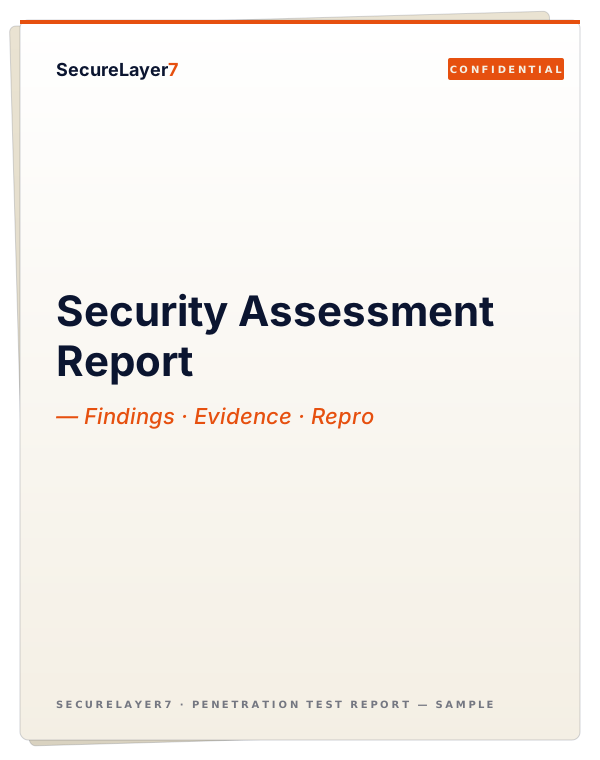
A pre-vetted engagement sample: full attack narrative, working proof-of-exploit, dev-ready fixes, and an auditor-ready summary. We email it within the hour.