Pentests that clear yournext security review.
The deal in your pipeline asks for SOC 2 Type II and a current pentest report. Your stack is Auth0 or Clerk, Postgres RLS or schema-per-tenant, Stripe Connect, signed webhooks, an admin API your support team uses every day. Our engagements stage tenant isolation drift, signing bypass, and admin-API IDOR as reproducible PoCs. Reports map to SOC 2 CC controls, ISO 27001 Annex A, and the customer security questionnaire your buyer just sent.
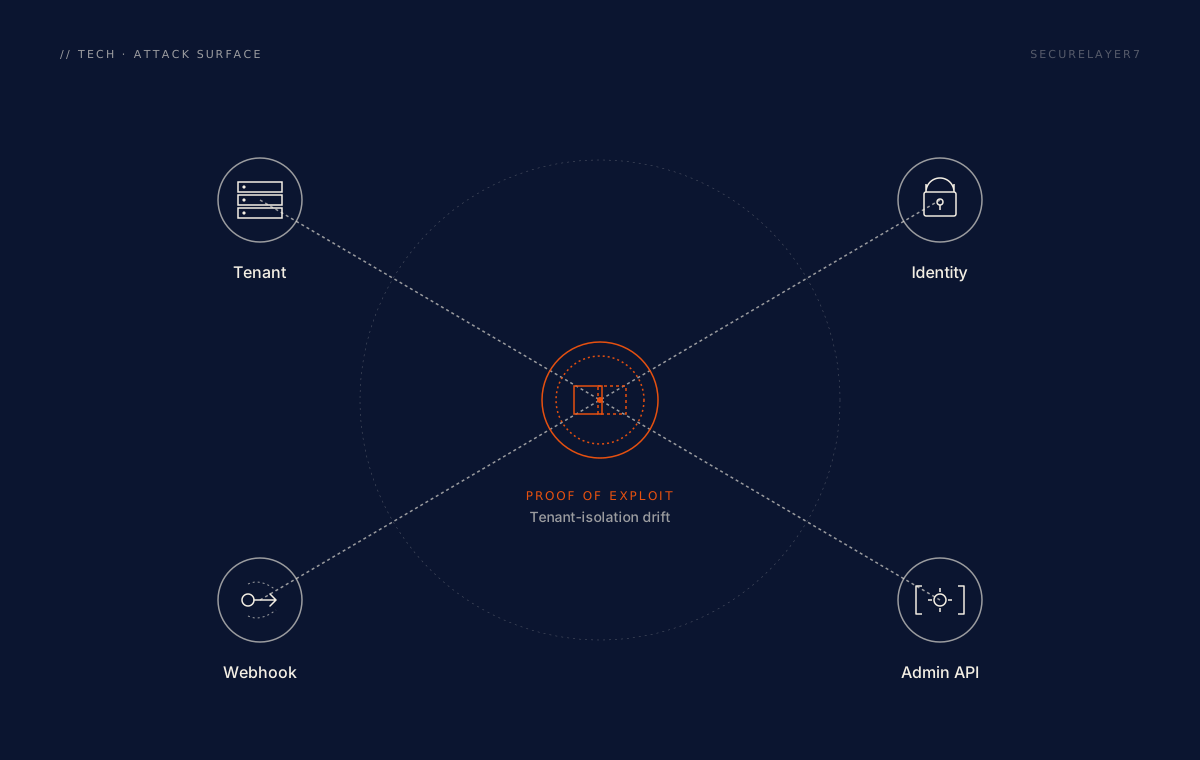
Tenant boundaries, by hand
Cross-tenant IDOR across record IDs, slugs, integration tokens, search APIs, and Stripe Connect account IDs.
Working proof-of-exploit
Captured Clerk session bypass, Auth0 scope drift, webhook replay traces. Not a checklist score.
Re-test included
Every finding re-tested after fixes ship. Written closure for SOC 2 Type II and customer-procurement evidence.
Three ways we test an early-stage SaaS.
Auth, tenant isolation, webhook signing, admin APIs, the AI feature you just shipped. Pick the engagement that fits the gate in front of you.

BugDazz Autonomous
Continuous coverage between SOC 2 Type II cycles. Catches drift on tenant isolation, Clerk or Auth0 scopes, webhook HMAC and timestamp checks, admin APIs. Re-tests every push.

Red team engagement
For the Series B buyer asking, have you ever had a red team test you. MITRE ATT&CK-mapped, no heads-up to your on-call. Output reads like an incident write-up.

AI and LLM pentest
Tests the customer-facing copilot you just shipped. Prompt injection, cross-tenant data exfil via retrieval, function-call abuse, system-prompt extraction.
Trusted by security teams across Fintech, SaaS & Education, Enterprise & Telecom, Security & Critical Infrastructure




On record



Why a startup pentest is different
Your buyer is asking for evidence, not a 200-page report.
An enterprise pentest is scoped against committees: AppSec, IR, compliance, a CISO. Yours is scoped against a security questionnaire (CAIQ, SIG Lite), a SOC 2 Type II auditor, and the customer's security team reviewing your trust center on a Thursday afternoon. We scope tight, turn in two to three weeks, and write the report against the artifact your buyer pastes into Drata or Vanta. One platform team gets the findings. The next deal moves.
Scope.
Every surface in a startup stack. Not just the OWASP top ten.
Eight surfaces we exercise on every startup engagement. Tenant isolation and auth sit at the top; background workers and SSO close the loop.
Multi-tenant isolation
Postgres RLS bypass, schema isolation drift, cross-tenant IDOR across record IDs, slugs, integration tokens, search APIs.
Auth (Auth0, Clerk, Supabase, custom JWT)
Session bypass, OAuth scope drift, JWT verification gaps, refresh-token replay, social-login account takeover.
Webhook signing (HMAC + timestamp)
Secret leakage, signature wrap, replay-window abuse, Stripe-style timestamp tolerance flaws, event-source spoofing.
Admin APIs and impersonation
Super-admin endpoint reachability, support-impersonation paths to production data, internal-tool allowlist drift.
Customer-facing copilot (LLM + retrieval)
Prompt injection, cross-tenant exfil through RAG, function-call abuse, system-prompt extraction, unsafe tool calls.
Payment integration (Stripe Connect)
Account-ID enumeration, payment-intent tampering, refund-logic abuse, Connect onboarding bypass, webhook race on charge state.
SSO and SCIM (Series B readiness)
SAML signature wrap, OAuth scope drift, SCIM admin-role escalation, JIT-provisioning race for Okta, Azure AD, Google Workspace.
Background workers and queues
Queue poisoning, job-scope drift across tenants, retry-storm abuse, worker-secret exposure, scheduled-job impersonation.
STAGE GATES.
The gates a pentest clears.
Procurement asks for current pentest evidence. Report maps to CC4 and CC7 controls your auditor reviews.
Vendor security questionnaire wants pentest scope, frequency, and remediation evidence. We answer the questions in the report.
Lead investor's diligence partner asks for two-year pentest history with re-test closure. Free re-test gives you the closure file.
Drata or Vanta wants an attestation letter plus the redacted report. Both arrive in the engagement closing email.
Customer asks how you tested the LLM feature. Prompt-injection, retrieval-exfil, and function-call abuse covered in the same engagement.
Technical vulnerability assessment with re-test maps to Annex A.12.6.1. Same report, no second engagement.
STARTUP ATTACK SURFACE.
What an attacker chains to cross tenants in an early-stage SaaS that shipped fast and audited later.
- 01Postgres RLS bypass to cross-tenant read
Missing policy on a JSONB column or an unindexed admin query, returning rows from a tenant the request had no right to read.
- 02Clerk or Auth0 session reuse to admin takeover
Refresh-token replay, social-login linking, or scope drift granting workspace-admin to a user who signed up an hour ago.
- 03Webhook signing bypass to state poisoning
Missing header treated as valid, replay-window left at five minutes, injected events flipping subscription, role, or integration state.
- 04Admin API IDOR via support impersonation
Support tool exposed past its allowlist, impersonation endpoint reachable from a customer session, full cross-tenant read.
- 05Prompt injection to cross-tenant retrieval exfil
Customer-facing copilot reads from a shared vector index, attacker-supplied content steers retrieval into another tenant's documents.
- 06Stripe Connect account-ID enumeration
Sequential account IDs and weak ownership checks let an attacker view or refund charges on a different connected account.
- 07Background job poisoning to tenant crossover
Queue payload trusted across tenant context, worker executes a job scoped to the wrong tenant, side effects land in the wrong workspace.
CHAIN CLASSES WE SEE IN SERIES A AND B SAAS.
STARTUP METHODOLOGY.
Five phases. Tight scope, fast turn.
Scoped to your tenant model, your auth provider, and the one customer deal in front of you. Two to three weeks from kick-off to report.
- 01Scope against the deal in front of you
- 02Auth and tenant boundary audit
- 03Webhook, admin API, and integration probe
- 04AI feature and worker review
- 05Chained finding, report, and free re-test
Meet our expert
One named lead, seed to Series C.
John Dill
vCISO at SecureLayer7
10+
Years in offensive security
300+
Engagements led
99.7%
On-time delivery rate
John scopes startup engagements against the tenant model, the auth provider, and the customer deal driving the timeline. He guides the pod from kick-off through final report and free re-test.
- Scopes startup engagements against your tenant model, auth provider, and the customer deal driving the timeline.
- Owns kick-off, mid-engagement check-ins, and live walkthrough of every chained finding.
- Drives remediation review and free re-test until every tenant-crossing path is closed.

Ready to scope a startup pentest? Book 30 minutes with John to walk through your tenant model, auth stack, and the deal driving the timeline.
Book a 30-min callFounder questions
What founders ask before signing a startup pentest.
Seven questions we hear from founders and technical leads at Series A and Series B SaaS. Answered against our methodology and your auditor.
Show all 7 questionsShow less
Question not listed here?
Next security review
Scope a pentest that clears your next security review.
Tenant model, auth provider, payment surface, and the AI feature you just shipped, exercised by a CREST-conducted pod. Report mapped to SOC 2 CC controls, ISO 27001 Annex A, and the customer security questionnaire your buyer just sent. Free re-test after fixes ship.