Pentests for the APIsthat move money.
Modern fintech moves money through APIs the OWASP Top 10 was never written for. We chain open-banking IDOR, OAuth-2 confusion, and payment-rail race conditions into one proof-of-exploit. Reports accepted by PCI DSS, SOC 2, RBI, MAS, and DORA auditors.
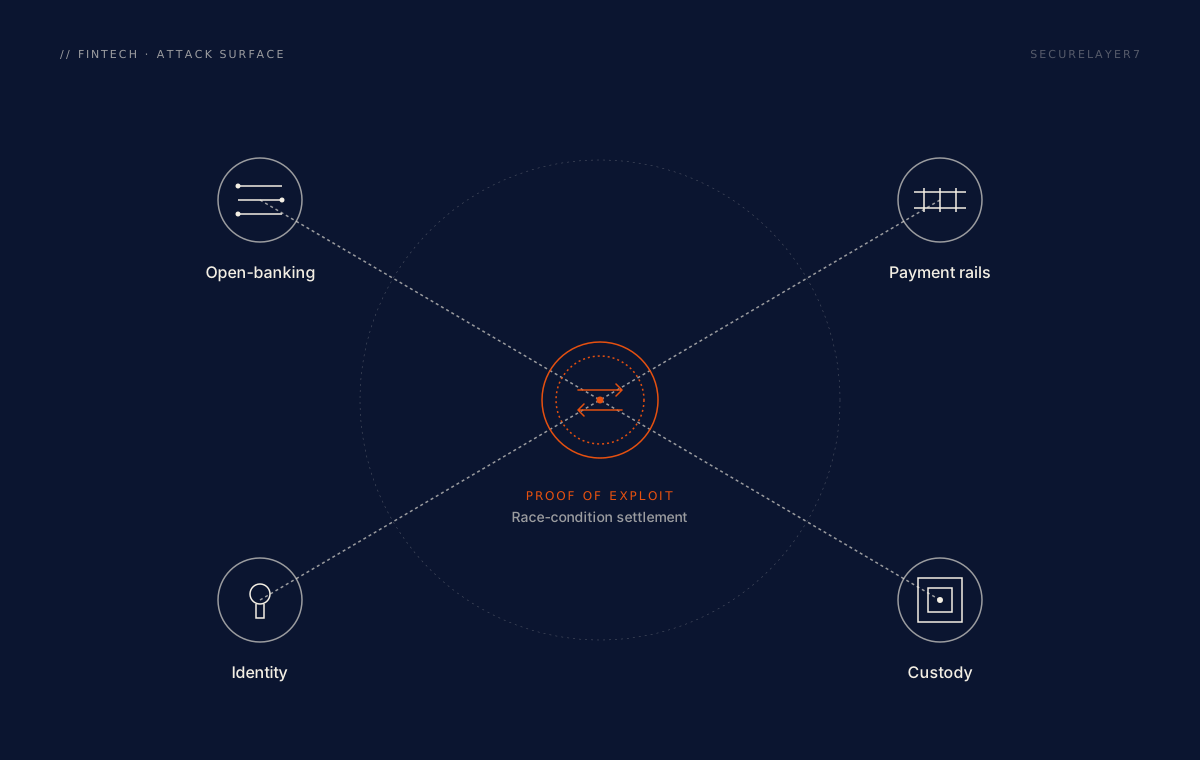
Fintech-specific chain classes
Open-banking IDOR, OAuth-2 scope drift, JWT alg confusion, RTP race, tokenization-vault bypass. Eight named classes, not OWASP boilerplate.
Working proof-of-exploit
Captured request traces, signed JWT diffs, race-window timing, and tokenization PAN paths. Not a checklist score.
Re-test included
Every finding re-tested after your team ships the fix. Written closure per finding.
Three ways we secure US fintech.
Open-banking APIs, BaaS sponsor-bank stacks, and KYC copilots each break differently. Pick the engagement that matches the risk your auditor will not catch.

BugDazz Autonomous
Continuous coverage between annual SOC 2 and PCI DSS 4.0 cycles. Catches drift on OAuth-2 scopes and open-banking endpoints the auditor only tested once.

Red team engagement
Multi-week adversary emulation without a heads-up, MITRE ATT&CK-mapped. Tests whether your SOC catches treasury fraud and SWIFT-adjacent settlement abuse before NYDFS 23 NYCRR 500 reporting kicks in.

AI and LLM pentest
Tests the KYC copilots and support chatbots your bank now ships. Prompt injection, cross-tenant data exfil, and chained jailbreaks against the model and its tools.
Trusted by security teams across Fintech, SaaS & Education, Enterprise & Telecom, Security & Critical Infrastructure




On record



Why a PCI checklist isn't a pentest
A control marked compliant is not a money path closed.
PCI DSS, SOC 2, and DORA grade controls. A fintech with every control green can still hand an attacker a signed JWT that drains a customer wallet. SecureLayer7's testers chain what the checklist calls compliant: an OAuth-2 PSP refresh-flow that downgrades scope, a tokenization vault that returns PAN under a forged HMAC, a UPI callback that races collection against settlement. Then we walk you through the proof your auditor will accept and your team will fix.
IN SCOPE.
Where we look across your fintech stack.
PSP/PISP/AISP flows, refresh-token reuse, alg-confusion, KYC document-replay and anti-fraud rule evasion.
UPI, FedNow, PIX, SEPA-instant race conditions; double-spend windows; tokenization-vault bypass and BIN-range abuse.
IDOR across consent grants, scope-downgrade, third-party-provider impersonation across the directory.
Hot-wallet key extraction, MPC threshold bypass, signing-oracle abuse, bridge withdrawal-replay and oracle manipulation.
FINTECH ATTACK SURFACE.
What an attacker chains to move money out of a modern fintech stack.
- 01IDOR + consent grant
Open-banking consent-grant ID collides across tenants. Attacker enumerates grants, reads or moves funds from another tenant’s account.
- 02OAuth-2 scope drift
Refresh-token flow returns an access token with a wider scope than the original grant. Customer token escalates to admin scope on the PSP API.
- 03JWT alg confusion
RS256/HS256 alg switch or kid hijack. Signed assertion forged with the public key, fintech API treats it as authentic and impersonates the customer.
- 04RTP race condition
UPI, FedNow, PIX, or SEPA-instant callback races settlement. Two concurrent transfers debit once, credit twice. Reconciliation runs after the window closes.
- 05Cert-pinning bypass
Mobile-trading app pin-bypass via Frida hook or repackage. Session cookie + device-binding token intercepted, trading account hijacked from the attacker’s device.
- 06Tokenization-vault bypass
Vault returns PAN under a forged HMAC or replayed detokenize call. PAN exfiltrated without ever touching the PCI-scoped database.
- 07Oracle manipulation
Crypto-bridge price oracle skewed, withdrawal-replay against the cheaper-leg side. Funds removed from the bridge before the oracle update lands.
FINTECH-SPECIFIC CHAIN CLASSES.
Scope -
Eight fintech attack surfaces. Tested by hand, every engagement.
Every fintech engagement is threat-modelled to your stack - the PSPs you front, the rails you settle on, the chains you bridge to. We exercise every named class by hand. No template, no auto-scan.
Open banking + consent APIs
IDOR across consent grants, scope-downgrade, third-party-provider impersonation.
Real-time payment rails
Race conditions on UPI, FedNow, PIX, SEPA instant; double-spend windows.
OAuth-2 + JWT fintech flows
alg confusion, kid hijack, scope drift across PSP, PISP, AISP.
Card and tokenization
PAN exposure paths, tokenization-vault bypass, BIN-range abuse.
Custody and wallet
Hot-wallet key extraction, MPC threshold bypass, signing oracle abuse.
KYC + onboarding
Document liveness bypass, ID-doc replay, anti-fraud rule evasion.
Crypto on-ramps + bridges
Withdrawal-replay, slippage abuse, oracle manipulation.
Mobile trading apps
Cert-pinning bypass, root-detect bypass, deep-link account takeover.
FINTECH PENTEST METHODOLOGY.
Eight phases. Compliance-aware, closed-loop.
Threat-modelled to your PSPs, payment rails, and regulator. Not a template we run against every fintech.
- 01Compliance + payment-rail surface mapping
- 02OAuth-2 + JWT audit
- 03Open-banking + consent boundary testing
- 04Payment-rail race + double-spend probe
- 05Mobile + trading-app runtime
- 06Chained finding + regulator-ready report
- 07Free re-test
- 08Detection-engineering handoff
Insights
Fintech security Resources.
OAuth-2 drift, RTP race conditions, and the open-banking bugs our reviewers keep finding in production fintech APIs.


Meet your engagement lead
One lead who knows fintech threat models.
John Dill
vCISO at SecureLayer7
10+
Years in offensive security
300+
Engagements led
99.7%
On-time delivery rate
John scopes fintech engagements against your PSP topology, open-banking directory, and the rails you settle on. He guides the pod from kick-off through final report and re-test.
- Scopes single-PSP, multi-PSP, and full open-banking-directory engagements against your real risk model.
- Owns kick-off, mid-engagement check-ins, and live walkthrough of every finding.
- Drives remediation review and re-test until every money-movement path is closed.

Ready to scope a fintech pentest? Book 30 minutes with John to walk through your PSP topology, rails, and timeline.
Book a 30-min callCommon procurement questions
What fintech buyers askbefore signing the SOW.
Six questions procurement teams send before signing a fintech pentest SOW. Answered against our methodology and your regulator.
Show all 6 questionsShow less
Have a procurement question not listed here?
Partner tear-sheet
Hand a 2-page FinTech tear-sheet to the buyer.
A printable summary your partner can drop into a pitch deck: named FinTech threats, methodology, compliance mapping, and the engagement leads to call. Saves as PDF from the browser.
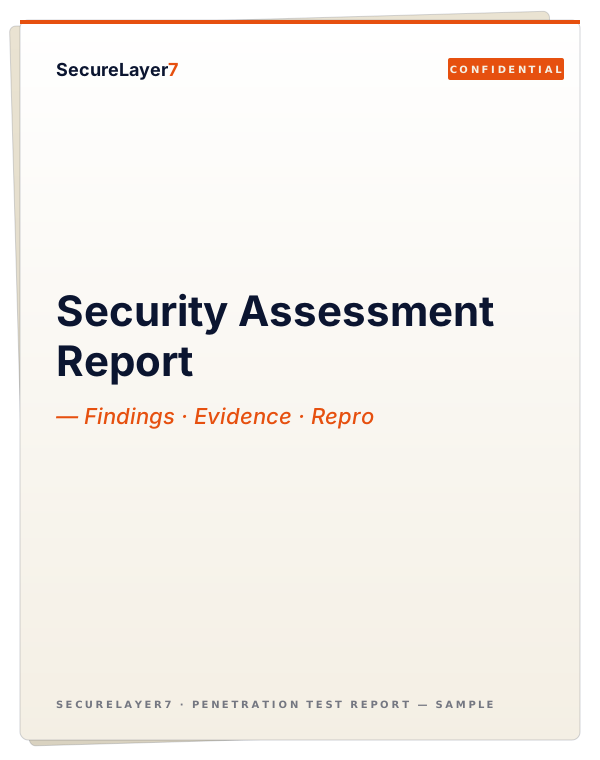
Sample engagement report
See what arrives in your inbox.
A pre-vetted sample fintech report: full kill chain across open-banking + RTP, working PoC traces, JWT diffs, and re-test scope. Sent on request after a 5-minute scoping call.