Pentests for multi-tenant SaaS,the way your auditor will read them.
Multi-tenant isolation, webhook signing, SCIM provisioning, admin APIs, the surfaces your auditor flags and your customer-procurement teams test in their security review. Our engagements stage isolation drift, signing bypass, and admin-API IDOR as reproducible PoCs. Reports accepted by SOC 2 Type II, ISO 27001, GDPR, and customer-procurement teams.
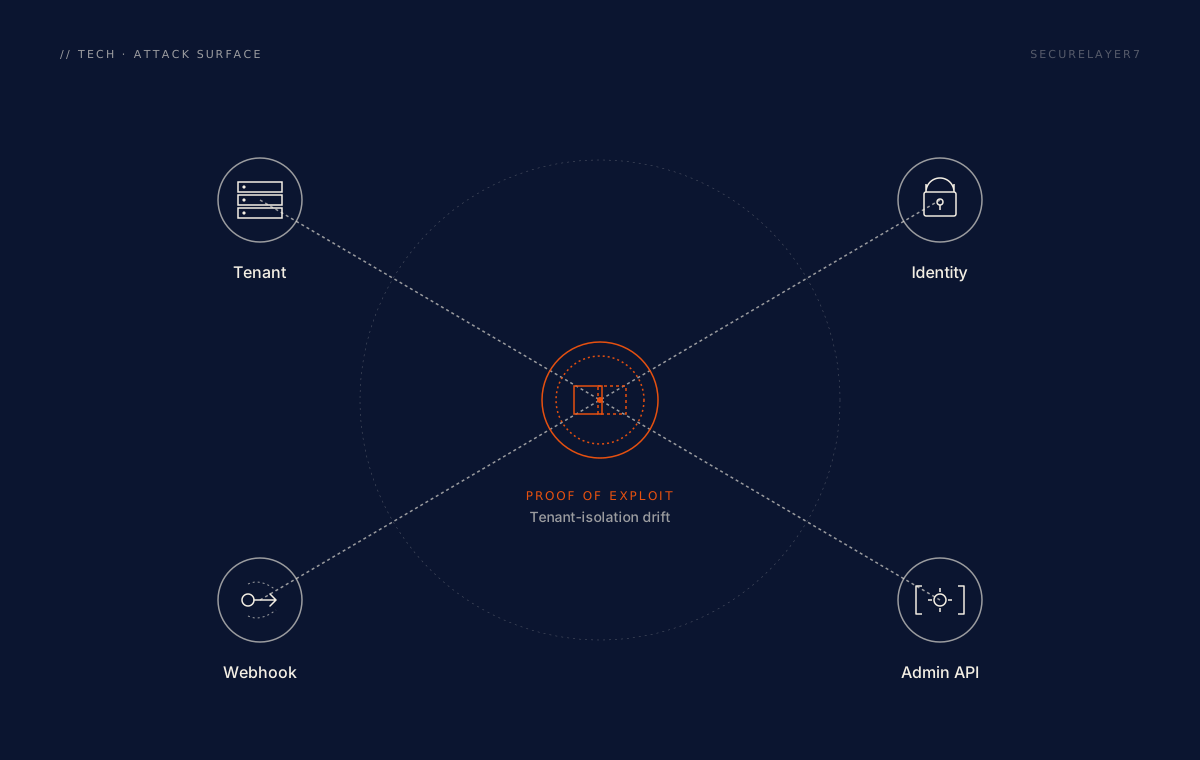
Tenant boundaries, by hand
Cross-tenant IDOR across record IDs, slugs, integration tokens, search APIs, and billing meters.
Working proof-of-exploit
Captured SAML wrap, SCIM role-escalation transcripts, webhook replay traces. Not a checklist score.
Re-test included
Every finding re-tested after fixes ship. Written closure for SOC 2 + ISO 27001 evidence.
Three ways we test multi-tenant SaaS.
Tenant isolation, webhook signing, SCIM, admin APIs, customer-facing copilots. Pick the engagement that fits where your product is right now.

BugDazz Autonomous
Runs between SOC 2 cycles against tenant boundaries, OAuth scopes, SCIM flows, webhook HMAC and timestamp checks, and admin APIs. Re-tests every push.

Red team engagement
Adversary emulation against your production admin APIs and customer-tenant boundaries, with no warning to the on-call rotation. Output reads like an incident write-up.

AI and LLM pentest
Tests customer copilots and internal agents for prompt injection, cross-tenant data exfil via retrieval, function-call abuse, and system-prompt extraction.
Trusted by security teams across Fintech, SaaS & Education, Enterprise & Telecom, Security & Critical Infrastructure




On record



Why a SOC 2 audit isn't a pentest
A control marked effective is not a tenant boundary held.
SOC 2 Type II tells your auditor that the control runs. It does not tell anyone whether a paying tenant can read another tenant's data through an admin-API parameter that nobody on your team has touched in six months. SecureLayer7's pentesters chain the surfaces the audit grades green: a webhook signature that fails open on a missing header, a SCIM provisioning race that grants workspace-admin to a deactivated user, an audit-log endpoint that accepts an injected event with the wrong tenant ID. Then we walk the proof your auditor will accept and your team will fix.
Scope
Every SaaS attack surface. Not just the OWASP top ten.
Six surfaces we exercise on every tech SaaS engagement. Multi-tenant isolation and identity sit at the top; data-export and supply-chain close the loop.
Multi-tenant isolation
Cross-tenant IDOR across record IDs, slug prediction, integration-token replay, search-API boundary leaks, billing-meter tampering.
OAuth, SSO, SCIM provisioning
SAML signature wrap, OAuth scope drift, SCIM admin-role escalation, JIT-provisioning race across Okta, Azure AD, Google Workspace, Jumpcloud.
Admin API and internal tools
Retool-class admin exposure, super-admin scope creep, internal-API allowlist drift, support-impersonation paths to production data.
Webhook signing and replay
Webhook-secret leakage, signature wrap, replay-window abuse, integration-partner trust boundary, event-source spoofing.
Audit log and SOC 2 evidence
Log tampering, retention bypass, audit-event injection, after-the-fact rewrite, tenant-scoped log exfil.
Data export, rate-limit, supply chain
Bulk-export drift, GDPR subject-access boundary, per-tenant rate-limit bypass, free-tier escape, dependency confusion, secrets-in-history.
IN SCOPE.
Where we look across a tech SaaS stack.
Record-level, workspace-level, organization-level boundaries probed across IDs, slugs, search APIs, and integration tokens.
Scope drift, signature wrap, role-escalation, JIT race across every supported IDP.
Signing bypass, replay-window abuse, super-admin scope, internal-tool exposure.
Log integrity, retention, audit-event injection, subject-access boundary, bulk-export drift.
TECH SAAS ATTACK SURFACE.
What an attacker chains to cross tenant boundaries in a modern SaaS stack.
- 01Cross-tenant IDOR
Record-ID, slug, or integration-token leak across workspaces, exfiltrating another tenant's customer data through the same product API.
- 02SAML signature wrap to admin takeover
IDP response re-wrapped to swap the subject, granting workspace-admin or org-owner in a single sign-on flow.
- 03SCIM role-escalation to workspace admin
SCIM patch on a deactivated user races provisioning, lands an attacker role inside the target tenant before deprovisioning settles.
- 04Webhook signing bypass to state poisoning
Missing signature header treated as valid, replay-window left open, injected events flip billing, role, or integration state.
- 05Audit-log tampering to SOC 2 evidence gap
Log retention bypass or audit-event injection rewrites the trail, breaking the evidence chain your auditor needs for CC controls.
- 06Admin-API exposure to super-admin access
Internal-tool allowlist drift or support-impersonation endpoint reachable from outside, granting cross-tenant read or write.
- 07Dependency confusion to build-pipeline RCE
Namespace squat or registry-priority flip lands attacker code inside CI, with secrets and signing keys reachable from the build runner.
MULTI-TENANT CHAIN CLASSES.
TECH SAAS METHODOLOGY.
Eight phases. Tenant-aware, evidence-ready.
Threat-modelled to your tenant graph, IDP topology, and integration partners. Not a template we run against every SaaS.
- 01Tenant model and boundary mapping
- 02OAuth, SCIM, SSO chain audit
- 03Admin-API surface enumeration
- 04Webhook signing and replay probe
- 05Audit-log integrity and retention review
- 06Data export and GDPR boundary
- 07Source code and dependency audit
- 08Chained finding, report, and free re-test
Meet our expert
One lead who knows multi-tenant SaaS.
John Dill
vCISO at SecureLayer7
10+
Years in offensive security
300+
Engagements led
99.7%
On-time delivery rate
John scopes tech SaaS engagements against your tenant model, IDP topology, and integration partners. He guides the pod from kick-off through final report and free re-test.
- Scopes single-product and multi-product engagements against your real tenant model and IDP topology.
- Owns kick-off, mid-engagement check-ins, and live walkthrough of every chained finding.
- Drives remediation review and free re-test until every tenant-crossing path is closed.

Ready to scope a SaaS pentest? Book 30 minutes with John to walk through your tenant model, IDP topology, and timeline.
Book a 30-min callCommon procurement questions
What buyers ask about SaaS penetration testing.
Six questions procurement and security-review teams send before signing a SaaS pentest SOW. Answered against our methodology and your auditor.
Show all 6 questionsShow less
Have a procurement question not listed here?
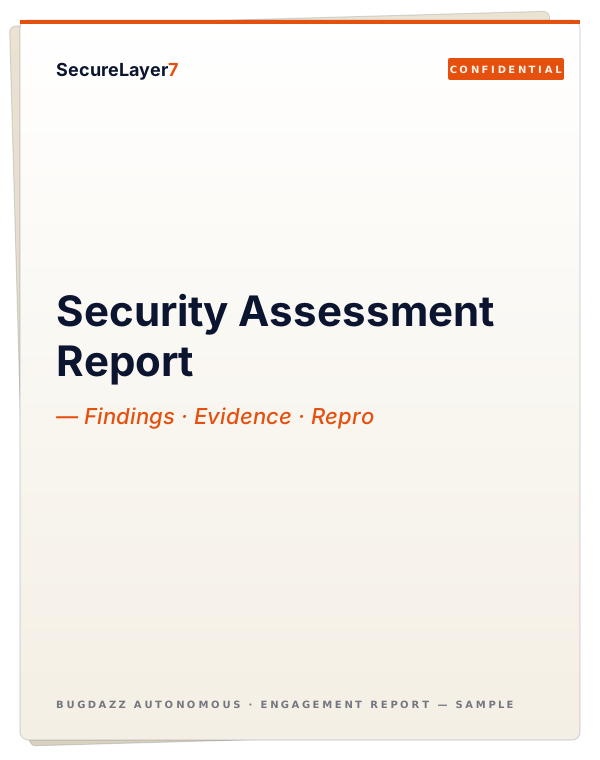
Sample engagement report
See what arrives in your inbox.
A pre-vetted sample SaaS pentest report: full tenant-crossing kill chain, working proof-of-exploit traces, SOC 2 CC and ISO 27001 Annex A mapping, and re-test scope. Sent on request after a 5-minute scoping call.