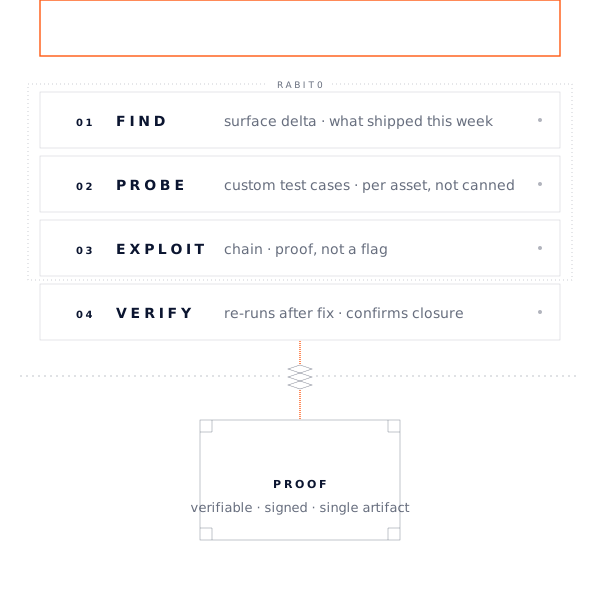

How BugDazz Autonomous works –

How Autonomous gets tothe exploit.

What Autonomous tests, how the engine attacks, and the validated proof of exploit you receive.

Trusted by security teams across Fintech, SaaS & Education, Enterprise & Telecom, Security & Critical Infrastructure

Airbase
Quiltt
Pacvue
Imagine Learning

Beyond the checklist —

Frameworks set the floor. Business logic finds the ceiling.

Every engagement starts from published doctrine. The AI agents read the asset's auth, state, and decision paths, then write per-asset cases against business logic your code alone knows. Exploits that close deals live beyond the checklist.

OWASP and MITRE map where to look. The surface itself shows what breaks. Discovery on request — domain, ASN, or SaaS tenant.

API

OWASP API Top 10·OAS / contract

Object-level authorisation, mass assignment, unrestricted resource consumption — and the business flows the contract documents but the scanner skips. We diff the contract against the implementation, then test the gap.
Web

OWASP Top 10·OWASP ASVS

Authentication, authorisation, business-logic flaws, chained injections — the Top-10 classes are baseline. Per-asset work covers state machines, multi-step flows, and the auth boundaries your scanner cannot model.

Active Directory

MITRE ATT&CK·TA0006 · TA0008

The credential-access and lateral-movement chains real red teams use. Mapped to ATT&CK techniques, executed against your tenant — domain trust, delegation paths, ACLs, and the misconfigurations checklists never reach.

Inside the engine —

Composed for offense. Gated for trust.

Rabit0-gated egress · VPC-only execution

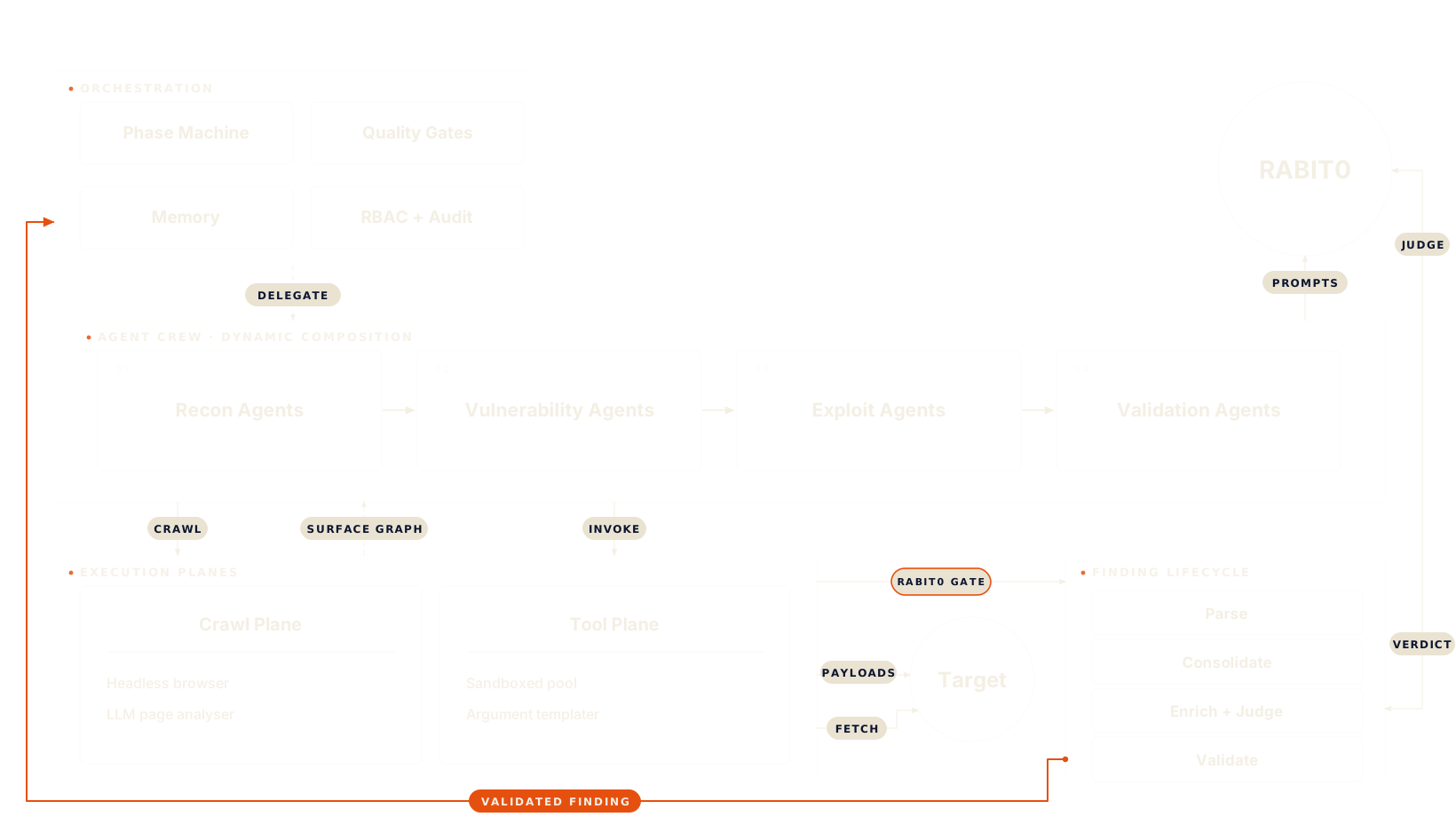
Specialist agents per phase — Recon, Vulnerability, Exploit, Validation. Every payload, finding, and verdict crosses the Rabit0 trust layer before it leaves.

BugDazz Offensive — platform architecture: Orchestration (Phase Machine, Quality Gates, Memory, RBAC + Audit), Rabit0 (validation gateway), Agent Crew with four phase-aligned crews (Recon, Vulnerability, Exploit, Validation), Execution Planes (Crawl + Tool, VPC-only), Target, and Finding Lifecycle (Parse, Consolidate, Enrich + Judge, Validate)
  • Orchestration

    Phase Machine

    Walks the engagement through Recon, Vulnerability, Exploit, Validation. Enforces order; no skipping.

  • Orchestration

    Quality Gates

    Stops the run if scope, evidence, or signal quality fall below threshold.

  • Orchestration

    Memory

    Single source of truth across phases — graph, hypotheses, evidence, prior runs.

  • Orchestration

    RBAC + Audit

    Per-engagement access control. Every agent action signed and logged for replay.

  • AI Trust Layer

    Rabit0

    Validation gateway. Sanitises payloads in, judges findings out, gates egress.

  • Agent Crew · 01

    Recon Agents

    Map the in-scope attack surface. Build the graph downstream phases consume.

  • Agent Crew · 02

    Vulnerability Agents

    Hypothesise weaknesses, probe with reversible checks, triage before escalating.

  • Agent Crew · 03

    Exploit Agents

    Chain safe proof-of-concept exploits to demonstrate real impact. No destructive operations.

  • Agent Crew · 04

    Validation Agents

    Reproduce findings end-to-end before release. Every verdict runs through Rabit0.

  • Execution Planes

    Crawl Plane

    Headless browser pool plus LLM page analyser — handles SPAs, auth, forms.

  • Execution Planes

    Tool Plane

    Sandboxed pentest tools invoked via templated arguments. Each call isolated and rate-limited.

  • Engagement

    Target

    The customer asset under test. Actions stay in scope.

  • Finding Lifecycle · 01

    Parse

    Normalise raw tool output into structured records — one schema, every source.

  • Finding Lifecycle · 02

    Consolidate

    Deduplicate against prior runs and sibling agents. One bug, one record.

  • Finding Lifecycle · 03

    Enrich + Judge

    Add CVE, CWE, business-impact context. Rabit0 judges for false positives.

  • Finding Lifecycle · 04

    Validate

    Reproduce end-to-end. Only verified findings flow back as a validated finding.

Production-safe —

Run on production. With controls.

BugDazz Autonomous has been delivered against live production environments since the platform shipped. Quality gates halt the run on threshold breach, probes are reversible by default, tools sit in a sandboxed pool, and execution stays VPC-only — the engine never leaves your boundary.

Quality gates

Configurable thresholds halt the engagement at any breach. Failures escalate to a human; nothing auto-merges.

Reversible probes

Vulnerability agents probe with low-impact reversible checks. Exploit agents chain safe proof-of-concept payloads. No destructive operations on customer assets.

Sandboxed tool pool

Every tool invocation runs in an isolated, rate-limited pool. Argument-templated execution; no shell-injection paths.

VPC-only execution

Crawler and tool services on internal ALB. No public ingress on engagement workers. Credentials Fernet-encrypted in AWS Secrets Manager; database in private subnets.

In the chair —

Every phase visible. Every action signed.

Engagement state — current phase, in-flight payload, agent decisions — written to a signed event log scoped to your tenant. Quality gates halt the run at any threshold breach for human review.

Phase machine

Recon → Vulnerability → Exploit → Validation. State and current agent visible at every transition.

Action log

Every agent decision and HTTP exchange signed, attributed, and ordered. RBAC-scoped to your tenant.

Quality gates

Configurable thresholds halt the engagement for review. Failures escalate; nothing auto-merges.

Validation pass

Findings reproduced end-to-end before sign-off. Re-run hook fires the moment you ship the patch.

What ships —

Evidence your team can act on.Evidence your auditor signs off.

Every engagement closes with the artefacts engineering, security, and audit teams need — same evidence, multiple lenses.

  • Executive PDF

    Risk story for the leadership team. Findings ranked, scope shown, methodology cited.

  • Technical PDF

    Per-finding repro: request, response, impact, fix, ATT&CK technique ID.

  • JSON evidence bundle

    Signed event log + finding records. Replayable end-to-end.

  • Live portal dashboard

    Open findings, status, retest hooks. RBAC-scoped to your tenant.

  • Re-verification

    Hook fires the moment you ship the patch. PASS or FAIL written back to the dashboard.

  • Compliance-ready report

    Per-engagement findings mapped to SOC 2, ISO/IEC 27001, PCI DSS, HIPAA, and CERT-In control requirements. Auditor-format variants on request.

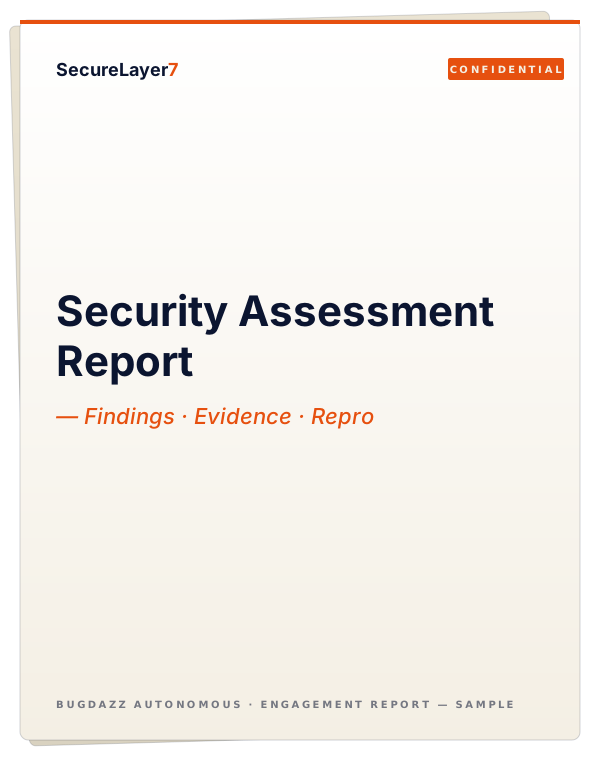
BugDazz engagement report — sample cover page

Sample report

See what arrives in your inbox.

Pre-vetted sample engagement report — all artefacts, all sections, redacted for share.

What customers ask —

Questions buyers bring to the technical review.

Show all 8 questions

Methodology & coverage

AI safety · Rabit0

Compliance

Different scope or constraint?

AI in our engagements —

Where AI runs. Where a human signs.

AI accelerates recon, surface mapping, and report drafting. CREST-accredited researchers chain the exploit and sign every finding. We publish the handoff per phase so your auditor can read it.

How AI fits in our pentest engagements →

Try it on your stack —

Bring a surface from your stack. Get back a proven exploit.

Pick the surface — the tier sets scope, runtime, and deliverables. Priced up front.