AI-assisted penetration testing
Two researchers with AI copilotsout-find five without.
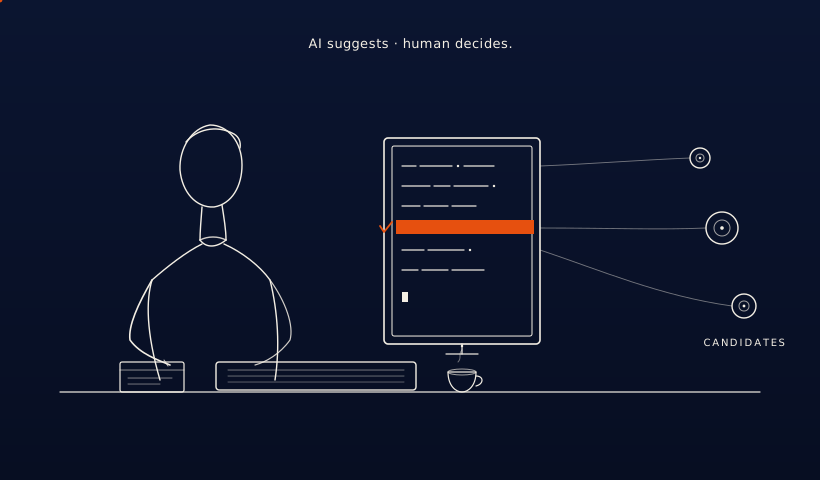
82% of top bug bounty hunters now run AI in their workflow (Bugcrowd 2026). Our researchers do too, with audit-grade controls a freelance hunter cannot give you, and a working proof-of-exploit signed by a human for every finding.
Trusted by security teams across Fintech, SaaS & Education, Enterprise & Telecom, Security & Critical Infrastructure




Audit-grade controls
The accreditations your auditor already accepts.
CREST, CERT-In, SOC 2 Type II, and ISO/IEC 27001 govern every report we ship. Including the ones where AI drafted the first pass. Audit-grade controls so AI-augmented findings land in an auditor-ready report, not a Slack screenshot.
 CRESTAccredited company & testers
 SOC 2 Type IIEngagement controls audited
 ISO/IEC 27001Information Security Management
Where AI multiplies coverage
Four jobs our AI copilots handle for our researchers.
These are the jobs our researchers used to spend three days on. AI copilots compress them to hours. The researcher spends the freed time on exploit chaining and impact analysis.
Recon triage
10k subdomains, certs, exposed admins, leaked credentials. AI ranks the 50 worth a human-day, with a reason per row. Replaces a researcher burning a week on manual sweep.
JavaScript at scale
Minified bundle to behaviour map. Endpoint inventory, role hints, hidden parameters, cred patterns. The researcher-grade JS analysis a traditional pentester routinely skips.
Report drafting
Working note to triager-ready write-up. Title, reproduction steps, named bug class, severity rationale. The researcher rewrites for clarity and signs.
IDOR + tenant diff
Two users, two responses, diffed. Object IDs mapped across workflows. Authorization bugs surfaced as candidate findings before the researcher chains them.
Where a researcher ships the bug
Four jobs only a researcher can do.
The jobs AI-only vendors quietly skip, and a freelance bug bounty hunter running Claude Code cannot deliver to a CISO. Our CREST-accredited researchers do.
Business-logic chains
AI doesn't know your invariants. Roles, asset graph, money flow. A researcher reads your app like an attacker and chains primitives into a kill chain.
Working proof-of-exploit
A finding without a PoC is a guess. The researcher runs the chained exploit, captures the request trail, ships the video your dev team can replay.
Impact in your language
Severity is not CVSS alone. The researcher maps each finding to the asset it threatens and writes the line your auditor and CFO both read.
CREST signature on every page
Every report leaves with a CREST-accredited researcher's name on it. No AI signature. No auto-published findings. One throat to choke.
How we keep AI safe to use
Rabit0. The trust layer between AI and your data.
Rabit0 sanitizes client data before any model sees it. No customer code, secrets, or PII enters model context. High-severity candidates route through multiple models, and a finding only advances when independent runs agree. Guardrails block AI from auto-publishing or auto-emailing. Every AI-touched artefact records to an immutable audit log. This is the layer a freelance hunter using ChatGPT cannot give you.

How the handoff runs
Six phases. One named owner per phase.
Every phase of an AI-assisted pentest engagement has a named owner: AI or researcher. No ambiguity. We publish the boundary so your auditor can read it.
- 01Scope + threat-model
- 02Recon + surface mapping
- 03Pattern-driven discovery
- 04Manual exploit + chaining
- 05Report drafting + review
- 06Fix-verify re-test
The third path
“Traditional pentest firms run 2019 methodology and miss what an AI copilot would surface in an hour. A freelance bug bounty hunter with Claude Code finds bugs fast but cannot sign an auditor-ready report. We are the third path. Researchers running the same modern AI stack the top HackerOne hunters use, under CREST accreditation and audit-grade controls. Speed of a hunter. Signature your auditor accepts.”
AI-assisted pentest runs on
AI-assisted penetration testing across six engagement types.
The AI / researcher boundary applies the same way across every pentest we ship. Pick the engagement that matches your scope. The methodology is identical.
Web application pentest
Auth bypass, IDOR, business-logic flaws, SSRF, deserialization. AI maps endpoints and diffs tenant responses, the researcher chains the kill chain.
Mobile app pentest
iOS + Android, native + Flutter + React Native. AI maps the bundle and IPC surface, the researcher drives the runtime exploit.
Cloud pentest. AWS · Azure · GCP
IMDSv1 SSRF, IAM role-chain abuse, Lambda over-privilege, AKS pod-identity. AI inventories the control plane, the researcher chains identity.
Source code audit
AI surfaces pattern matches across the codebase, including AI-generated-code drift. The researcher audits invariants and signs off on severity.
Red team assessment
AI handles open-source recon, lookalike domains, and leaked-credential checks. The researcher drives stealth, detection bypass, and the objective chain.
Smart contract audit
AI mines invariant-violation patterns across Solidity, Rust, and Move. The researcher writes the working PoC on a forked mainnet.
What CISOs actually ask
2026 buyer questionsabout AI-assisted pentesting.
This page covers our human-led, AI-assisted pentest engagement. For continuous, fully autonomous testing, see BugDazz Autonomous, a separate product line.
Show all 8 questionsShow less
Have a procurement question not listed here? Mark our reply.
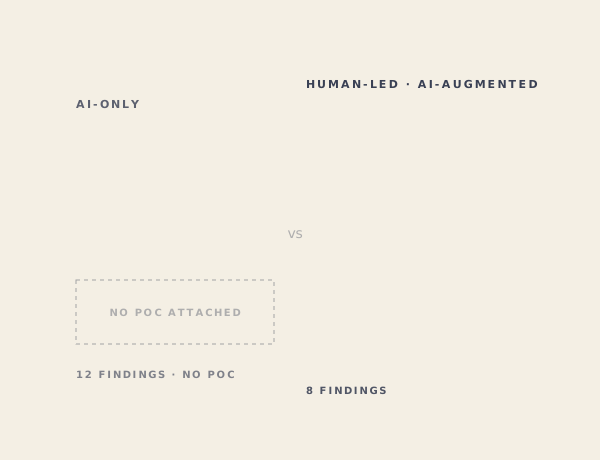
Sample comparison report
AI-only autonomous vs. AI-assisted human-led.
A redactable PDF showing the same target run two ways: AI-only autonomous baseline vs. SL7 AI-assisted human-led engagement. Side-by-side findings, named bug classes, false-positive rates, time-to-PoC.