Enterprise penetration testing
Enterprise Penetration TestingSix surfaces, one pod, one report.
External, internal, Active Directory, cloud, web, and email, one pod, one SOW, one report. Findings chain across pillars instead of dying in vendor handoffs.
Six surfaces, one incident: attackers chain through whichever you pentested LAST.
Trusted by security teams across Fintech, SaaS & Education, Enterprise & Telecom, Security & Critical Infrastructure




On record
Accreditation that holds up under buyer-side diligence.
CREST for the testers and the company. CERT-In for India regulatory filings. SOC 2 Type II for engagement controls. ISO/IEC 27001 across the management system.
 CRESTAccredited company & testers
 SOC 2 Type IIIndependently audited
 ISO/IEC 27001Information Security Management
How one shop covers six pillars
Findings don't die in a vendor handoff.
Most security teams run five single-pillar pentest firms in parallel, one for AppSec, one for AD, one for cloud, one for phishing, one for the perimeter. Five vendors return five reports. One pod returns one attack story, phish into AD into cloud into the app, chained on a single timeline. Your auditor reads one report. Your dev team gets one ranked backlog.
ENGAGEMENT SCALE.
Who actually shows up to a 20-person engagement, and why.
- 01Pod lead
Owns scope, OPSEC, timeline, and the customer thread through re-test.
- 02Surface specialists
Web, API, AD, cloud, OT. Picked per your stack, not a generic checklist.
- 03Code & binary review
Source audit, decompilation, exploit-primitive work for chained findings.
- 04Adversary-emulation operator
TTP execution against your specific blue-team stack. Tradecraft over tooling.
- 05Detection-engineering liaison
Walks the SOC through what they missed and how to instrument the gap.
- 06Report writer
Per-finding narrative, proof-of-exploit, code-level remediation. CREST-aligned.
What we cover
Six surfaces in one enterprise penetration testing engagement.
Each surface scoped against named bug classes, not generic checklists. One pod chains findings across surfaces, so a phishing foothold can follow into AD and then into the cloud on the same SOW.
External perimeter
Subdomain takeover, exposed admin panels on edge devices, default credentials on appliances, leaked credentials in paste sites and code repos. Inventory feeds the internal phase.
Internal network
SMB relay, Kerberoasting, NTLM hash capture, lateral movement via WMI and PsExec, unconstrained delegation paths. Assumed-breach foothold, then chain to identity.
Active Directory / identity
ADCS ESC1–ESC8 abuse, constrained delegation, DCSync, BloodHound paths to Domain Admin, Entra ID conditional-access bypass. Identity is treated as its own surface, not a footnote.
Cloud: AWS · Azure · GCP
IMDSv1 SSRF, IAM role-chain abuse, S3 enumeration and policy gaps, Lambda over-privilege, AKS pod-identity abuse, GCP service-account impersonation across projects.
Web applications + APIs
Authentication bypass, IDOR, business-logic flaws, SSRF into cloud metadata, deserialization, GraphQL introspection abuse, broken object-property authorization on REST.
Email · phishing · OAuth abuse
Sender spoofing on misconfigured SPF/DMARC, MFA fatigue, browser-in-browser pretexts, OAuth consent grant abuse against M365 and Workspace tenants.
How we pentest
Eight phases. Every finding verified closed-loop.
Each engagement is scoped to your application's architecture, user roles, and business logic, not a generic checklist. We chain findings into real exploit paths, then re-test every fix at no extra cost.
Reconnaissance & Enumeration
Map the full attack surface, subdomains, endpoints, tech stack, exposed services, and third-party integrations.
Scoping & Threat Modelling
Define test boundaries, identify high-value assets, and model attacker paths specific to your application and user roles.
Static Analysis
Review client-side code, JavaScript bundles, and API schemas for logic leaks, hardcoded secrets, and insecure patterns.
Dynamic Analysis
Active testing of running application, input fuzzing, authentication bypass, session manipulation, and flow abuse.
App & API Analysis
Deep-dive on REST and GraphQL endpoints: mass assignment, IDOR, broken object-level auth, rate limiting gaps, and injection.
Vulnerability Analysis
Correlate findings, chain vulnerabilities into real exploit paths, and assign CVSS scores with business impact context.
Remediation Guidance
Prioritised remediation guidance, not just CVE references. Developer-ready fixes with code examples where needed.
Patch Verification
Free re-test of all findings once fixes are deployed. Closed-loop confirmation that vulnerabilities are fully resolved.
How an enterprise engagement runs ,
Five phases. One closed loop.
A written plan before traffic flows, four execution phases that chain findings across surfaces, and a consolidated report with a free re-test on the same scope. No phase ends until its evidence is in the report.
Threat-model & scoping
Enumerate the surfaces in scope, the business-critical assets behind each, the attacker objectives that matter to the board, and the rules of engagement. Output: a written engagement plan with named bug classes per pillar, signed off by your security lead before a single packet flows.
External + reconnaissance
Subdomain enumeration, certificate-transparency mining, leaked-credential checks across paste sites and breach corpora, exposed-admin discovery on edge devices and SaaS tenants. The inventory and any initial footholds are handed cleanly to the internal phase.
Internal + identity
Assumed-breach foothold on a workstation segment, then Active Directory path discovery, Kerberoasting, ADCS ESC8, unconstrained delegation, BloodHound graphs to Domain Admin. Lateral movement is chained against business assets, not isolated as a finding count.
Cloud + applications
The same pod pivots from on-prem identity into AWS, Azure, and GCP control planes, then into the web and API attack surface above them. Findings chain across, phish to AD to cloud to app, and are written as one kill chain, not four bullet lists.
Report & re-test
One consolidated report with chained-finding narratives, code-level remediation, CREST-mapped severity, and PoC artifacts your dev team can replay. A free re-test on the same scope once fixes land, with a delta report for the auditor.
Insights
Enterprise programs Resources.
How our engagement leads scope multi-asset pentests across web, network, and cloud, plus operator write-ups from past enterprise programs.


Rule of the engagement
“Five vendors will hand you five finding counts. One pod hands you one attack story, the phish that lit up identity, the identity path that reached the cloud, the cloud key that read your app's database, written so your dev team can fix it in a sprint and your auditor can read it in a sitting.”
Meet your engagement architect
One lead through all six surfaces.
John Dill
vCISO at SecureLayer7
200+
engagements scoped
6
surfaces in one SOW
14 yr
SL7 offensive lineage
John scopes the multi-pillar engagement, writes the SOW with named bug classes per surface, and stays on the line into the pod through execution. When your dev team has a remediation question on a cloud finding that started as a phish, the answer comes back from the person who scoped the work, not a five-vendor email thread.
Read the redactable sample report.
Ready to scope your red-team engagement? Book a 30-minute call.
Book a 30-min callCommon procurement questions
What buyers ask about enterprise penetration testing.
Six questions procurement teams send before signing an enterprise pentest SOW. Answered against our methodology and your auditor.
Show all 6 questionsShow less
Have a procurement question not listed here?
Tested by industry.
The bug classes named below come from real engagements in each sector. Pick the closest fit.

FinTech
Enterprise banking estates, treasury operations, SWIFT-adjacent settlement.

Tech SaaS
Multi-tenant SaaS at enterprise scale, admin APIs, customer-tenant boundaries.

HealthTech
Hospital-network estates, EHR cores, billing systems, telehealth perimeters.
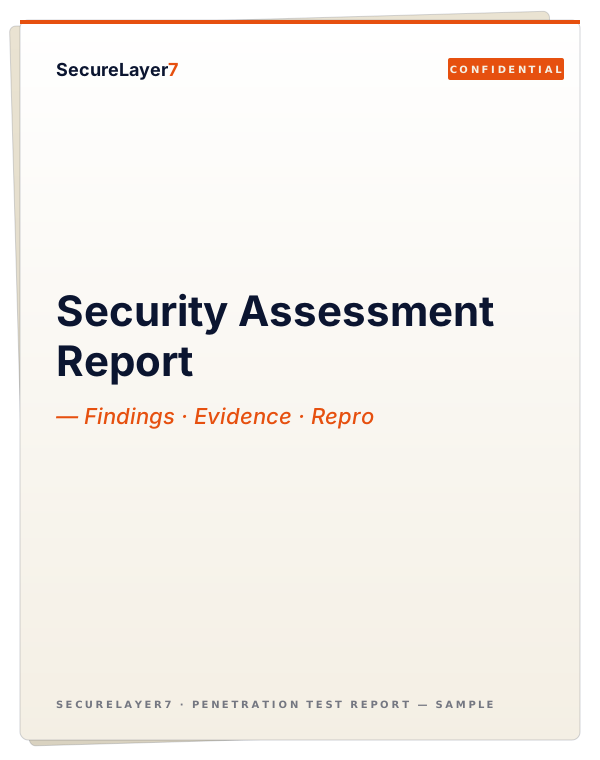
Sample enterprise engagement report
Read the report before you scope.
A redactable PDF of a real enterprise engagement: chained findings across perimeter, identity, and cloud; CREST severity; PoC artifacts; diff-style remediation. Sent after a short scoping call so we can match the redaction to your sector.