A network's blueprintisn't its security model.
Network Architecture Review reads your topology, segmentation, and identity boundaries against an attacker's reachability, not against the diagram. SecureLayer7 walks the network with your architects, interviews the operators who actually run it, and returns the gaps a documentation review never catches: flat partner VLANs, third-party paths into core, missing east-west controls, BCP failover that re-opens routes.

Topology + interview
Architecture diagrams reviewed alongside the operators who built them, not in isolation.
Reachability over rulebook
Segmentation, third-party paths, and identity boundaries scored on what an attacker can actually reach.
Findings with fixes
Each gap arrives with the policy, route, or control change that closes it, and a re-walk to verify.
Trusted by security teams across Fintech, SaaS & Education, Enterprise & Telecom, Security & Critical Infrastructure




On record



What we review —
Six surfaces. One review.
Each surface is read off the diagram, then walked with the operators who run it. Findings score on attacker reachability, not on policy compliance alone.
Segmentation & ACLs
VLAN boundaries, firewall rule density, east-west controls, and the segments that have quietly grown flat through years of exception rules.
Third-party & partner integration
VPN tunnels, MPLS hand-offs, SaaS connectors, and the partner-tenant paths that bypass your perimeter via a vendor’s allowlist.
Identity & access boundaries
Active Directory trust direction, RADIUS/TACACS scope, jump-host policy, service-account reachability across segments.
Topology, DMZ & exposure
Internet-facing posture, DMZ tenancy, NAT/PAT semantics, IPv6 dual-stack assumptions, management-plane exposure.
Security technology inventory
Firewalls, IDS/IPS, NDR, segmentation tooling, secrets vaults, EDR coverage map. Each control read for what it sees and what it does not.
Policy, BCP & recovery routes
Failover paths and DR sites tested as live network surface. A clean primary network with a flat DR path is one disaster from being flat-attacked.
Why a documentation review isn't an architecture review
What's drawn is rarely what's reachable.
Network diagrams describe intent. Real networks describe drift, the partner allowlist that became permanent, the management VLAN that someone routed for a vendor, the DMZ tenant that shares a back-channel with core. SecureLayer7 reads the diagram, then walks the running config and the people who maintain it. The gap between what's drawn and what's reachable is where the report lands.

Methodology for architecture review
Three phases. Each closes on evidence.
Documentation, interviews, and reachability tested in sequence. Every claim resolved before the report drafts.
- 01Information Gathering
- 02Analysis
- 03Recommendations
Meet your engagement lead
An engagement lead reads every brief.
Pruthvi Mahesh
Engagement Lead, Network & Architecture Reviews
14+
Years in offensive security
200+
Engagements scoped
99%
On-time delivery rate
Pruthvi scopes architecture-review engagements end to end, translating your topology, segmentation policy, and identity model into the interview agenda, the documents to pull, and the surfaces to test reachability against. He runs the engagement with the SecureLayer7 pod from kick-off through the in-person walkthrough.
- Scopes segmentation, third-party access, and DMZ tenancy against your real risk model.
- Owns kick-off, mid-engagement check-ins, and live presentation of every finding.
- Drives recommendation review and re-walk until each gap closes.

Ready to scope a Network Architecture Review? Book a 30-minute call with Pruthvi to walk through your topology, segmentation, and timeline.
Adjacent
Beyond the architecture review.


Sample engagement report
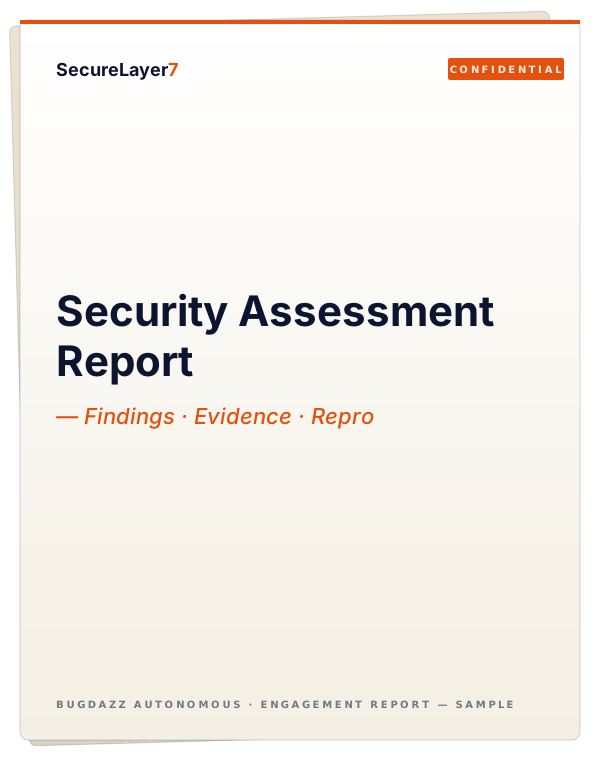
See what the architecture review puts in your inbox.
Sample report shows the gap narrative, segmentation evidence, control changes recommended, and the order to apply them. Sent on request after a 5-minute scoping call.