GCP penetration testingfrom one binding to project Owner.
Manual GCP penetration testing for Google Cloud Platform. We hunt named bug classes: Workload Identity Federation confusion, service account impersonation, Cloud Run trigger replay, GKE node pool escape, VPC Service Controls bypass.

GCP surfaces
VPC · IAM · GKE · Workload Identity Federation. One pod, one method, four control planes.

Working proof
Every finding ships with a working exploit transcript, code-level fix guidance, and a free re-test.

Compliance-ready
PCI DSS, HIPAA, ISO/IEC 27001, SOC 2 Type II. Your auditor reads the same artefact.
The window from vulnerability discovery to exploitation has gone from weeks to hours.
Trusted by security teams across Fintech, SaaS & Education, Enterprise & Telecom, Security & Critical Infrastructure




On record

What we test
Four GCP surfaces. One method.
Each surface scoped against named bug classes. We chain across them. A Workload Identity token misuse can land in BigQuery, exfiltrating data tagged for VPC Service Controls.
VPC + perimeter
VPC Service Controls bypass, firewall egress oversight, Identity-Aware Proxy misconfig, Cloud NAT exposure. Lateral movement chained inside the perimeter.
IAM + identity
Service account impersonation via iam.serviceAccounts.actAs, allow-policy plus deny-policy interaction gaps, Organization policy drift, custom-role privilege creep.
GKE + workloads
Node pool escape via privileged pod, GKE Autopilot constraint bypass, Workload Identity binding abuse, metadata API exposure inside the pod.
Storage + secrets
Cloud Storage bucket IAM, signed-URL leakage, Secret Manager accessor scope, Cloud KMS key policy bypass, Firestore unauth read.
From flag to exploit.
A flag passed is not a finding proven.
A passing posture check isn't a closed path. We chain flagged GCP findings, an over-broad service account, a token reachable from a workload, a permissive IAM binding, into the proof-of-exploit your dev team can fix and your auditor will accept.
GCP PENTEST METHODOLOGY.
Eight phases. One artifact.
Each GCP penetration testing engagement moves through eight phases and lands on one named artefact: a CREST-mapped severity rubric scored against your project invariants.
- 01Threat-model & scope
- 02Reconnaissance
- 03IAM & Workload Identity
- 04GKE & workload
- 05Data & secrets
- 06Perimeter & egress
- 07Report
- 08Re-test
Insights
GCP attack-path Resources.
Service-account chains, IAM condition gaps, and GCE/GKE pivots, write-ups from the reviewers who pentest Google Cloud estates.

Meet your engagement architect
One named lead from scope to close.
John Dill
vCISO at SecureLayer7
200+
engagements scoped
6
surfaces in one SOW
14 yr
SL7 offensive lineage
John scopes your GCP engagement, writes the SOW with named bug classes per surface, and stays on the line into the pod through execution.
Read the redactable sample report.
Pick a 30-minute slot. We will scope your engagement on the call.
Book a 30-min callTested by industry.
The bug classes named below come from real engagements in each sector. Pick the closest fit.



Built for Australia engagements
What changes when we deliver here.
Regulatory framework
ACSC Cloud Tenants per-control map
Compliance scoping
CPS 234 ¶21 capability grading
Local engagements
AU healthtech — 11 projects, Sydney region only
Local pricing
AUD per-project pricing, GST itemised
Compliance scoping
CDR Schedule 2 data-handling tag
Questions Australian GCP owners ask first.
Do you test VPC Service Controls bypass?
Yes. Perimeter and ingress / egress rule gaps are mapped to ACSC network segmentation guidance. Each bypass cites the GCP service and the customer-side fix.
How is CMEK / EKM graded?
Customer-managed key gaps cite ASD ISM cryptography controls. EKM with HSM in Australia is logged as evidence for CPS 234 ¶21.
What about the Workload Identity Federation surface?
Yes. WIF trust chains are tested. Findings flag federations that violate Essential 8 Strategy 6 MFA expectations.
Will the report help our CDR data-holder posture?
Yes. CDR Schedule 2 controls are tagged on data-handling findings. Useful for ACCC accreditation review of a GCP-hosted data holder.
Delivery in Australia
GCP Sydney. ACSC cloud. CPS 234 ¶21.
IAM, VPC Service Controls, and CMEK findings cite ACSC Cloud for Tenants guidance. CPS 234 ¶21 capability gaps are graded on the customer side only.
- Direct line
- +61-2-0000-0000
- Office
- Sydney, Australia
Frameworks scoped: ASD Essential 8 · APRA CPS 234 · Privacy Act · ISO/IEC 27001.
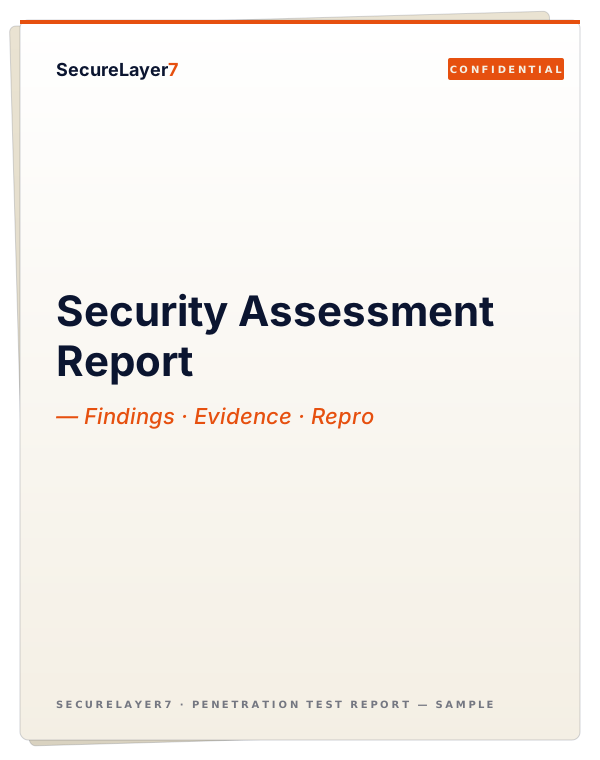
Sample GCP engagement report
See what arrives in your inbox.
A redactable PDF of a real GCP engagement: Workload Identity Federation chain, GKE node escape, Cloud Storage IAM leakage, with working PoC transcripts and CREST-mapped severity. Sent after a short scoping call.