
The attack that worked
A reproducible walkthrough of each finding: the input, the tool call, and the action it triggered.
Your agents do not just answer, they act: calling tools, holding credentials, moving data, triggering workflows. We test what an attacker could make them do through prompt injection, tool abuse, and excessive access, and hand your team the exact attack path and the fix.
The window from vulnerability discovery to exploitation has gone from weeks to hours.
On record
CREST is the standard for offensive security execution. CERT-In, SOC 2 Type II, and ISO/IEC 27001 cover how SecureLayer7 handles your prompts, your agent topology, and your engagement record. Those testers have found 40,000+ vulnerabilities for 1,000+ companies across 30+ countries.



The new blast radius
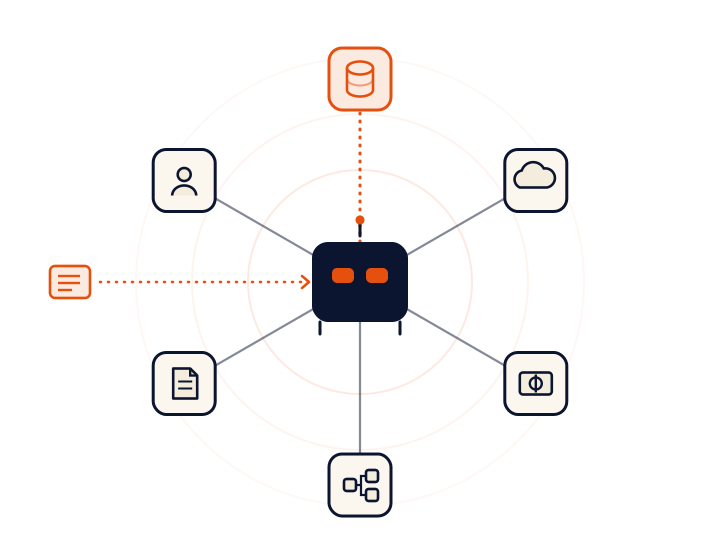
AI agents act on the world. They call tools, query databases, move money, and trigger workflows, usually with standing credentials and far more access than any single task needs. That is the exposure.
A single prompt injection, a poisoned document, or one compromised tool turns that access into an incident: data exfiltrated, records deleted, actions taken in your name. Model guardrails do not stop this, because the problem is not what the model says, it is what the agent is allowed to do.
The Agent Access Assessment
An agent is not a chatbot. It reads untrusted input, holds credentials, calls tools, and acts on your systems. So the real question is not whether it can be jailbroken, but what it can be made to do, and how far it can go. We test the whole agent, its tools and connectors, its identity, and everything downstream, then prove the impact end to end.


How we run it
SecureLayer7's offensive methodology.
We inventory every agent, its tools, its credentials, and what each can reach, then draw the trust boundaries an attacker would target.
We drive injection, tool abuse, and privilege paths against the running system the way a real attacker would, chaining what we find.
Every finding ships with a working attack, the trust boundary that failed, and a fix your developers can implement. Then we re-test.
What arrives
The attack that worked
A reproducible walkthrough of each finding: the input, the tool call, and the action it triggered.
The trust boundary that failed
Exactly where untrusted input reached a privileged action, so you fix the cause, not the symptom.
A developer-ready fix
Concrete remediation per finding: scoping, guardrails, human-in-loop gates, and identity changes.
A re-test
We verify every fix against the running system, so you can show the path is closed.
Meet our expert
vCISO at SecureLayer7
40,000+
Vulnerabilities found
1,000+
Customers secured
14 yrs
Offensive research
John scopes each agent engagement against your tools, credentials, and data topology, then leads the pod from kickoff through final report and re-test. The people testing your agents are the same offensive researchers who publish CVEs, not tool operators, and John signs off on every finding with a working attack against the running system.

Ready to test your agents? Book 30 minutes with John to walk through your tools, access, and timeline.
Book a 30-min callCommon questions
Scope an engagement
We test your agents against the OWASP Top 10 for Agentic Applications and hand your team the attack, the trust boundary that failed, and the fix, with a re-test to confirm it is closed.