Red Team Assessment
Red team assessmentthat proves the chain.
A full-spectrum red team engagement against your people, network, and applications. We assume the role of a real adversary, phishing, exposed services, chained CVEs, lateral movement, and report what they would have reached.
The next ransomware crew won't ring the doorbell, they'll arrive through your laptop's MFA cookie.
Trusted by security teams across Fintech, SaaS & Education, Enterprise & Telecom, Security & Critical Infrastructure




On record
Same accreditations on every engagement.
CREST is the standard for red team execution. CERT-In, SOC 2 Type II, and ISO/IEC 27001 cover how SecureLayer7 handles your environment, your data, and your engagement record.
 CRESTAccredited company & testers
 SOC 2 Type IIIndependently audited
 ISO/IEC 27001Information Security Management
The question red team answers
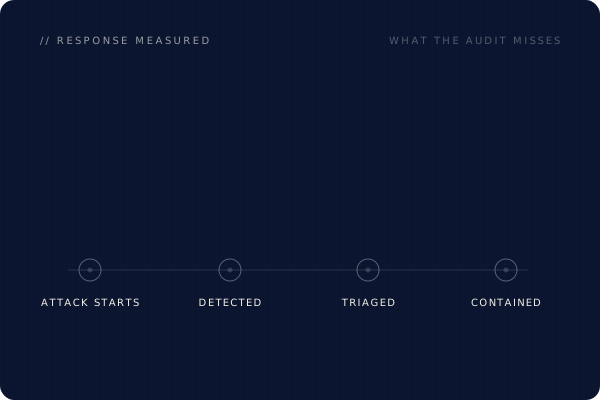
Annual pentests prove flaws. Red team proves the response.
Detection assumes a known attacker. Controls assume a known path. Red team replaces both assumptions with an adversary that adapts as your team responds, and reports how far they got, how long it took, and where the chain broke.
Pick the engagement
Three ways to run a red team.
Choose by what you're trying to prove. Scope is described in each card, see the next section for what each surface actually looks like in the field.
Assumed Breach
Starts with the attacker already inside. Tests whether your detection, identity controls, and IR runbooks contain the chain before it reaches a crown jewel.
Scope, Network · Identity · Application · Cloud.
DETECTION POSTURE.
How we run a year of engagements without a single blue-team find.
- 01Pre-engagement baseline
Map the target's noise floor before we move. Match the cadence.
- 02Low-and-slow tradecraft
Beacon jitter, sparse C2, traffic shaping under SOC anomaly thresholds.
- 03EDR-aware tooling
Tradecraft picked against the target's exact EDR fingerprint. Defeat the tool, not the operator.
- 04Burn-down protocol
If detection looks imminent, we pivot or pause. Extend timeline before we abort.
- 05Debrief, not disclosure
Blue team learns what they missed after the operation, not during it.
What the crew brings
Seven attack surfaces. One adversary.
These are the surfaces SecureLayer7's red team operates across. Black Box engagements run all seven. Assumed Breach and Threat-Led include the digital surfaces by default; physical, social, and wireless are scoped in when the engagement narrative requires them, not bolted on as upsells.
Network
External reconnaissance, internet-facing service exploitation, then internal east-west pivoting once foothold is established. Mapped to ATT&CK Initial Access + Lateral Movement.
Identity
Active Directory trust abuse, Kerberoasting, delegation paths, cloud-IAM lateral movement, credential theft chains, and the misconfigurations checklists never reach.
Application
Chained business-logic exploits, authentication confusion, multi-step flow abuse, and the auth boundaries scanners cannot model. Web, API, and SaaS-tenant boundaries.
Cloud
AWS / Azure / GCP IAM misuse, metadata-service abuse, secrets-manager pivoting, cross-account trust paths, and SaaS-tenant trust escalation. Scoped to the cloud surface area you actually run.
Physical
On-site reconnaissance, tailgating, badge cloning, lock bypass, and covert-access device placement on a wired network drop. Once inside, the digital crew picks up from the physical foothold. Engagement is consent-bounded, recorded, and de-escalated on first detection by your team.
Social engineering
Spear phishing, vishing, pretexting against helpdesk / IT support, MFA-fatigue prompts, and supply-chain personas (vendors, contractors, recruiters). Targets the humans your security awareness training assumes are trained.
Wireless
Rogue access points, evil-twin captive portals, EAP-credential capture, and segmentation-bypass paths from guest VLAN to corporate. Tested at your physical perimeter and inside acquired tenants.
Findings inside systems that already passed audit. The chain runs through gaps no checklist names.
“Compliance is a snapshot. Red team is the stress test the snapshot can't show, the chain an attacker actually walks when your auditor isn't watching.”
Methodology for red teaming
A tried, tested, and recognised process.
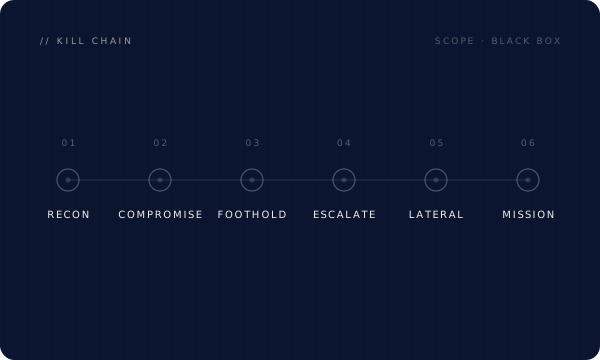
Three linear phases set the stage. Four iterate against your environment until the mission objective is reached. Mission completes; blue-team handoff and report close the engagement.
- 01Initial Reconnaissance
External reconnaissance, OSINT, and surface mapping. The operator team builds the graph downstream phases consume.
- 02Initial Compromise
Initial access via social engineering, exposed services, supply-chain paths, or chained CVEs. Non-destructive on customer assets.
- 03Establish Foothold
Persistent presence on the compromised host. C2 traffic, beaconing, and detection-evasion exercises.
- 04Maintain Presence
Hold the foothold through detection-and-response cycles. Beacon cadence, sleeper accounts, fail-back paths.
- 05Move Laterally
East-west traversal toward the agreed mission objective. Identity, network, and application paths.
- 06Escalate Privileges
Local-to-tenant escalation, AD trust abuse, cloud-IAM lateral paths.
- 07Internal Recon
Internal asset discovery and target identification within the compromised environment.
- 08Complete Mission
Mission objective achieved, the concrete crown jewel agreed in scoping. AWS root, production tenant, source-code repo, IdP admin, payment-key exfiltration. Exfil simulated only where consent applies.
- 09Blue-team Handoff
Per-finding MITRE ATT&CK technique IDs, Sigma detection rules, D3FEND mapping, and the IOC list. Your detection-engineering team picks up where the engagement leaves off.
- 10Report
Engineering, executive, and compliance reports, delivered through BugDazz PTaaS.
Identity-focused engagements.
When the kill chain runs through Active Directory.
Most red-team operations land at Domain Admin. If your scope is identity-first, ADCS, Kerberos, LAPS, delegation, hybrid identity, see the dedicated Active Directory Security Assessment. Same operators, same OPSEC discipline, focused on the forest.
Operator credentials
Proven expertise in offensive security operations.
Operators across the SecureLayer7 practice carry the certifications buyers ask procurement to verify.






Insights
Red Team Resources.
Operator write-ups from red-team engagements: assumed-breach paths, AD escalation, and the detection gaps we surface during exercises.


Meet our expert
John Dill
vCISO at SecureLayer7
15+
Years in offensive security
150+
Engagements led to date
99.99%
On-time engagement delivery
John leads engagement strategy for SecureLayer7's red-team practice. He scopes operations against the threats specific to each customer's environment, then carries findings through to board-level decisions and detection-engineering handoff.
- Leads CREST-conducted red-team operations from scoping to retest.
- Translates engagement findings into board-level risk decisions.
- Owns post-engagement detection-engineering handoff to the blue team.

Ready to scope a red-team engagement? Book 30 minutes with John to discuss objectives, scope, and timing.
Book a 30-min callCommon procurement questions
What buyers ask about red team assessment.
Six questions procurement teams send before signing a red team SOW. Answered against our methodology and your auditor.
Show all 6 questionsShow less
Have a procurement question not listed here?
Tested by industry.
The bug classes named below come from real engagements in each sector. Pick the closest fit.

FinTech
Unannounced engagements against treasury, settlement, and trading-floor detection.

Tech SaaS
Multi-week emulation across production admin APIs and customer-tenant boundaries.

Retail
POS-to-OMS chain tested without warning, fulfillment-hand-off detection measured.
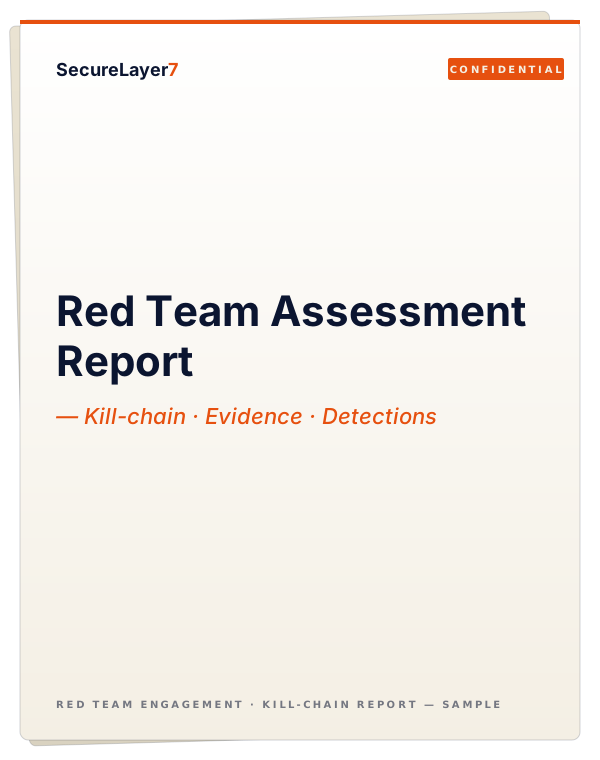
Sample engagement report
See what arrives in your inbox.
A pre-vetted sample report: full kill-chain narrative, all artefacts. Sent on request after a 5-minute scoping call.