Startup program
Startup Penetration TestingThe pentest report enterprise buyers expect.
Your enterprise customer asked for a pentest report. Your VC wants one before the next round. We ship a CREST-aligned pentest of one app, with the working proof and SOC 2-ready report your US buyers expect.

Your first enterprise buyer asks for a pentest report by week two of procurement.
Trusted by security teams across Fintech, SaaS & Education, Enterprise & Telecom, Security & Critical Infrastructure




On record


Why this price
Token-hours, not pentester-weeks.
A manual app pentest covering OWASP Top 10, business-logic flaws, auth bypass, injection, and IDOR runs 60 to 120 pentester-hours, which is why enterprise rates land in the tens of thousands. BugDazz Autonomous, SecureLayer7's LLM-driven pentest, runs the same exploit primitives under the same rules of engagement, but in LLM-token hours instead of pentester-weeks. The output is identical: working proof-of-exploit, CVSS-mapped findings, code-level fixes, and a retest. So $1,500 to $2,500 per engagement is the real cost of an Autonomous pentest plus a healthy margin, not a discount. A human engagement lead signs off on every finding before the report ships, the methodology and signoff are human, the work is Autonomous.
What's in the engagement
Six things and only these.
Fixed scope is why the price is fixed. Every startup engagement ships the same six deliverables, the same shape we ship to enterprise customers, sized to one app surface.
- Scope: one app surface
- Pick one, web app, mobile app, or API. Single environment, staging or prod. Auth complexity sets the price within the band.
- Coverage: OWASP Top 10 + business logic
- Injection, IDOR, broken auth, SSRF, deserialization, business-logic flaws, driven by BugDazz Autonomous, the same primitives a pentester chains.
- Findings: working proof-of-exploit
- Each finding ships with a reproducible attack trace, request/response pairs, and screenshots. Not a scanner JSON dump.
- Report: CREST-aligned, investor-DD ready
- Executive summary plus per-finding technical narrative, CVSS, and remediation guidance, the same report shape we ship to enterprise customers.
- Engagement lead signoff
- A named SL7 pod lead reviews and signs the report before it ships. Methodology and signoff are human, the work is Autonomous.
- Retest included
- One re-test after your team patches. No additional fee. Written confirmation each path is closed.
How we pentest
Eight phases. Every finding verified closed-loop.
Each engagement is scoped to your application's architecture, user roles, and business logic, not a generic checklist. We chain findings into real exploit paths, then re-test every fix at no extra cost.
Reconnaissance & Enumeration
Map the full attack surface, subdomains, endpoints, tech stack, exposed services, and third-party integrations.
Scoping & Threat Modelling
Define test boundaries, identify high-value assets, and model attacker paths specific to your application and user roles.
Static Analysis
Review client-side code, JavaScript bundles, and API schemas for logic leaks, hardcoded secrets, and insecure patterns.
Dynamic Analysis
Active testing of running application, input fuzzing, authentication bypass, session manipulation, and flow abuse.
App & API Analysis
Deep-dive on REST and GraphQL endpoints: mass assignment, IDOR, broken object-level auth, rate limiting gaps, and injection.
Vulnerability Analysis
Correlate findings, chain vulnerabilities into real exploit paths, and assign CVSS scores with business impact context.
Remediation Guidance
Prioritised remediation guidance, not just CVE references. Developer-ready fixes with code examples where needed.
Patch Verification
Free re-test of all findings once fixes are deployed. Closed-loop confirmation that vulnerabilities are fully resolved.
Insights
Startup security Resources.
Reading for first-time security buyers: how we sequence the first pentest, what auditors expect, and the bugs we keep finding in early-stage stacks.

Meet your engagement lead
One named lead, every engagement.
John Dill
vCISO at SecureLayer7
15+
Years in offensive security
150+
Engagements led to date
99.99%
On-time engagement delivery
John owns your startup-program engagement from scoping to re-test. A 30-minute kickoff, scope locked in writing, and a single point of contact through report and re-test. Every Autonomous finding is reviewed before signoff, so you receive verified exploit traces, not raw agent output.
- Locks scope in a 30-minute kickoff. One surface, one environment, one budget.
- Reviews every Autonomous finding before signoff. You get verified exploit traces, not raw output.
- Walks the report and runs the re-test. Direct line, not a ticketing queue.

Ready to scope your startup pentest? Book a 30-minute kickoff with John to lock surface, environment, and timeline.
Book a 30-min callProcurement questions
What buyers ask before scoping.
Eight questions founders and procurement leads send before booking a startup-program pentest. Answered against our scope rules, pricing tiers, and engagement-lead workflow.
Show all 8 questionsShow less
Have a procurement question not listed here?
Tested by industry.
The bug classes named below come from real engagements in each sector. Pick the closest fit.


Tech SaaS
Same engagement model your enterprise customers will demand at procurement.

Pass procurement and DD
Get the report your enterprise deal needs.
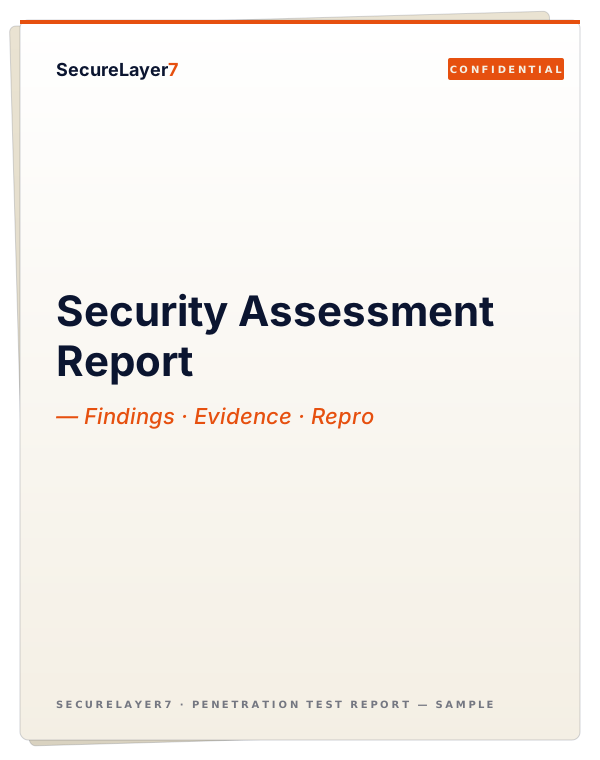
A 30-minute kickoff locks scope and confirms eligibility. After the engagement: full CREST-aligned report plus one re-test. Sample report available on request.