Telecom Network Security TestingCore, Signaling & SS7/SIGTRAN Coverage.
Validate SS7/SIGTRAN exposure, core segmentation, and control-plane weaknesses, risk-ranked findings your telecom security team can remediate without guesswork.
Signaling & interconnect
SS7/SIGTRAN exposure testing against realistic operator interconnect and abuse scenarios.
Core & air-interface posture
Core network elements, segmentation, and GSM/3G/LTE attack paths beyond checklist scanning.
Remediation + re-test
Prioritized fixes with verification, closed-loop outcomes for network engineering teams.
The window from vulnerability discovery to exploitation has gone from weeks to hours.
Trusted by security teams across Fintech, SaaS & Education, Enterprise & Telecom, Security & Critical Infrastructure




Telecom security ,
Assessments tied to how telecom fails in production. Not generic checklist work.
Attacks on telecom rarely stay in one layer, they cross signaling, core elements, and access edges. We scope around those boundaries so findings map to engineering work with clear risk, not scattered vulnerabilities on a spreadsheet.
Since 2012 we’ve tested operator-adjacent systems alongside enterprise apps and infrastructure, experience we use to model realistic paths, rank impact, and write remediation network teams can ship.
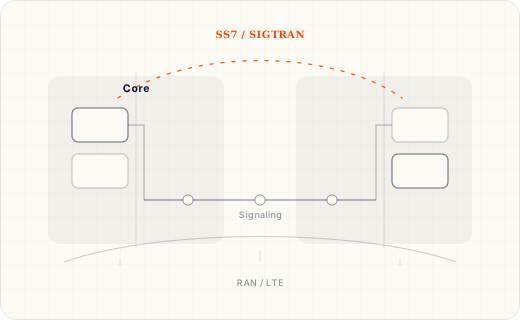
Reference scope: core, SS7/SIGTRAN interconnect, signaling trunk, RAN/LTE access
Coverage ,
Four planes we pressure-test. One engagement story.
We group telecom work into four themes, signaling, core stack, access edge, and enterprise voice, so planning stays readable. Pick what matches your risk focus; we tailor tasks inside each theme.
Signaling & interconnect
SS7 and SIGTRAN exposure, interconnect abuse paths, and protocol-level risks across peering, modeled for real operator handoffs, not generic scanning.
Core & mobile stack
GSM/3G core and LTE architecture reviews, segmentation and NE configuration, including MBSS-style baselines, so paths into HLR, SMSC-class systems and peers are explicit.
Access & subscriber edge
Air-interface penetration testing and SIM / USIM application security, where bypass, cloning, and misuse scenarios often show up before they touch core nodes.
Voice & enterprise telecom
IP-PBX, PSTN, and switching-adjacent environments reviewed for configuration drift, trunk abuse, and paths into the wider org.
Adjacent services ,
Often booked with telecom assessments. Same SL7 standards.
Pick the surface that matches your wider risk story.
Accreditations



Where the bugs live
Six trust boundaries, one chained engagement.
Carrier networks aren't one perimeter. They're a stack of trust boundaries, SS7, SIP, BGP, 5G SBI, IMS, roaming, each with its own protocols, its own filters, and its own assumption that the other side is friendly. We test from the attacker side of each boundary and chain the findings into the impact a board recognises: location leak, call hijack, route hijack, slice cross-read, VoLTE takeover, bearer redirect. The diagram lists the surface, what it carries, and the chained exploit we prove during the engagement. Each row also names the underlying finding class, what to fix once and stop seeing in next year's pentest.
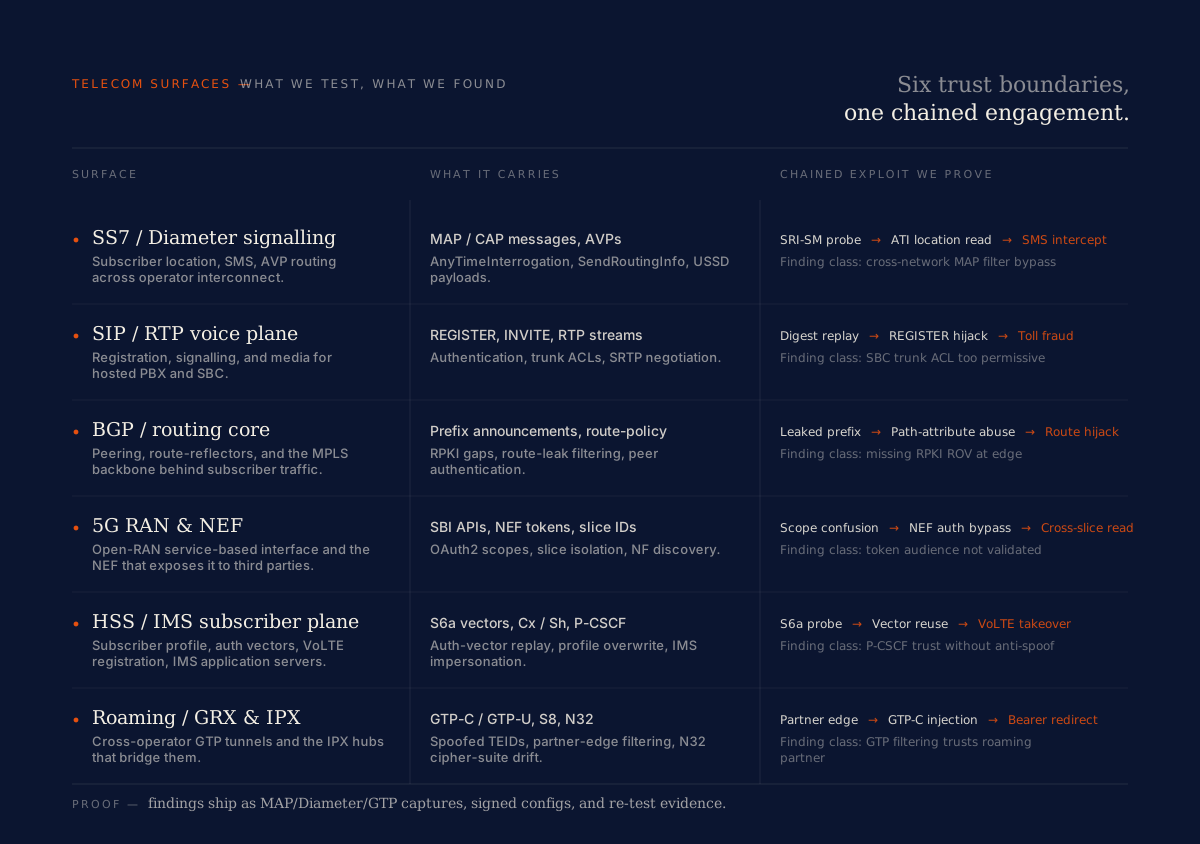
SS7 / Diameter · SIP / RTP · BGP · 5G NEF · IMS · Roaming
Insights
Telecom security Resources.
Carrier-grade pentest notes: SS7/Diameter exposure, GTP filtering gaps, and core-network segmentation reviews from telco engagements.


How we pentest
Eight phases. Every finding verified closed-loop.
Each engagement is scoped to your application's architecture, user roles, and business logic, not a generic checklist. We chain findings into real exploit paths, then re-test every fix at no extra cost.
Reconnaissance & Enumeration
Map the full attack surface, subdomains, endpoints, tech stack, exposed services, and third-party integrations.
Scoping & Threat Modelling
Define test boundaries, identify high-value assets, and model attacker paths specific to your application and user roles.
Static Analysis
Review client-side code, JavaScript bundles, and API schemas for logic leaks, hardcoded secrets, and insecure patterns.
Dynamic Analysis
Active testing of running application, input fuzzing, authentication bypass, session manipulation, and flow abuse.
App & API Analysis
Deep-dive on REST and GraphQL endpoints: mass assignment, IDOR, broken object-level auth, rate limiting gaps, and injection.
Vulnerability Analysis
Correlate findings, chain vulnerabilities into real exploit paths, and assign CVSS scores with business impact context.
Remediation Guidance
Prioritised remediation guidance, not just CVE references. Developer-ready fixes with code examples where needed.
Patch Verification
Free re-test of all findings once fixes are deployed. Closed-loop confirmation that vulnerabilities are fully resolved.
Tested by industry.
The bug classes named below come from real engagements in each sector. Pick the closest fit.

Tech SaaS
SaaS telco-platform pentests, signalling boundaries, BSS/OSS attack paths.

Built for United Kingdom engagements
What changes when we deliver here.
Compliance scoping
GSMA FS.11 signalling baseline coverage
Regulatory framework
UK TSA 2021 Code of Practice paragraph mapping
Local engagements
UK MVNO cleared TSA Tier-2 inspection after 6-week engagement
Local pricing
GBP per-interface fee, signalling probe travel included
Compliance scoping
Ofcom evidence templates filled by engagement lead
Telecoms testing, UK shape.
Do you cover Tier-1, 2 and 3 providers?
Yes. Scope adjusts to the TSA 2021 designation. Findings cite the Code of Practice paragraph applicable to the tier and the resilience measure.
How is signalling tested?
SS7, Diameter and SIP-I from a controlled probe. SCCP, MAP and CAMEL attack chains in scope. Findings cite GSMA FS.11 baseline.
Does the report fit Ofcom inspection?
Yes. TSA 2021 Code of Practice sub-measures and the Ofcom evidence templates. Engagement lead countersigns the submission.
Do you do 5G core?
Yes. SBA service-mesh, SUPI/SUCI handling and N-interface fuzzing. Findings cite 3GPP TS 33.501 and the TSA Code.
Delivery in United Kingdom
Telecoms pentest. TSA 2021 evidence.
Signalling, core and OSS/BSS findings map to the Telecommunications Security Act 2021 Code of Practice. Ofcom-format evidence on submission.
- Direct line
- +44-20-0000-0000
- Office
- London, United Kingdom
Frameworks scoped: CREST · NCSC CAF · UK GDPR · PCI DSS · ISO/IEC 27001.
Book a security posture review.
Scope telecom risks across your network architecture, signaling stack, and core services.
Meet our expert
John Dill
vCISO at SecureLayer7
15+
Years in offensive security
150+
Engagements led to date
99.99%
On-time engagement delivery
John scopes engagements against the threats specific to each customer’s environment and stays the security accountable executive across the work.
- Scopes CREST-conducted offensive engagements end-to-end.
- Translates findings into board-level risk decisions.
- Owns post-engagement detection-engineering handoff.

Pick a 30-minute slot. We will scope your engagement on the call.
Book a 30-min call