AI / LLM security assessment
AI and LLM Security AssessmentTest the agent before it lies for you.
We find what your AI agent will do for an attacker, and prove it. AI pentesters test your chatbot, RAG search, and tool-calling agent by hand. Every weakness arrives with a working exploit, the exact code change to fix it, and a re-test after you patch.
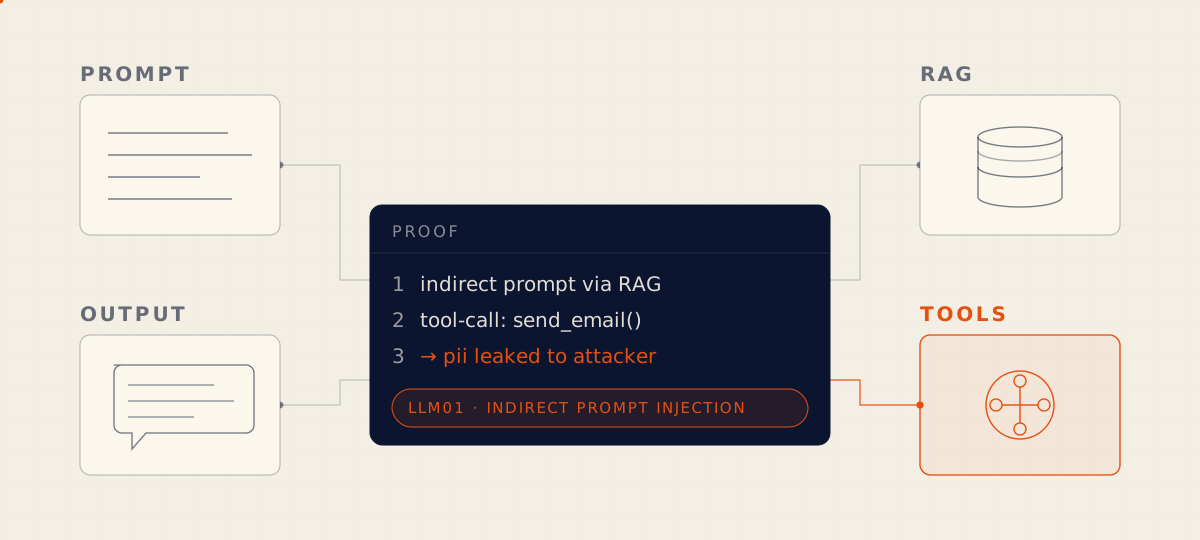
The window from vulnerability discovery to exploitation has gone from weeks to hours.
Trusted by security teams across Fintech, SaaS & Education, Enterprise & Telecom, Security & Critical Infrastructure




On record
Same accreditations on every engagement.
CREST is the standard for offensive security execution. CERT-In, SOC 2 Type II, and ISO/IEC 27001 cover how SecureLayer7 handles your prompts, your model artifacts, and your engagement record.
- NCSC CHECKApproved testing for HMG / regulated firms
 CRESTUK-recognised tester accreditation
- FCA SYSC 13.7Operational resilience evidence
 SOC 2 Type IIAICPA · TSC controls auditable
 ISO/IEC 27001Information security management
Adversarial by hand.
We cross-examine the model the way an attacker would.
Prompt injection doesn't show up in request shape or code paths. It shows up when a document tells your model to email a user's data out, and the model does it. Our AI pentesters run adversarial conversations against your real agent, chatbot, RAG search, and tool-calling, and show you exactly what it gives up.

Pick the engagement
Three ways we test AI. Pick by what you ship.
Every engagement is threat-modelled to your real surface, chat app, agent stack, or model artifact. Bug classes from the OWASP LLM Top 10 are exercised inside the mode that matches what you actually run in production.
LLM Application Pentest
Chat UIs, RAG-backed search, AI features inside a SaaS, exercised from scoping to retest. Direct + indirect prompt injection, system-prompt leakage, insecure output handling (XSS via markdown, RCE via eval'd code blocks, SSRF via rendered URLs). Tested against your real prompts and your real RAG corpus.



LLM AGENT ATTACK SURFACE.
Seven attack classes the buyer rarely sees in a scanner readout.
- 01Prompt injection
Direct user-input attacks that override the agent's system prompt.
- 02Indirect injection
Hostile content slipped through RAG documents or tool output.
- 03RAG-store poisoning
Tainted vector-store entries that flip the model's grounded facts.
- 04Tool-call confusion
Function-call hijacking and parameter tampering on agent actions.
- 05Identity spoofing
Agent impersonation across multi-agent or multi-tenant chains.
- 06Output exfiltration
Stealing secrets, PII, or schema through carefully shaped responses.
- 07Plan hijacking
Multi-step reasoning chains subverted mid-execution by adversarial input.
What we test
Six attack vectors. One engagement.
Every AI/LLM engagement covers the OWASP LLM Top 10 mapped to your real surface, model, prompt, RAG, tools, output, agent, supply chain. Threat-modelled to your application; exercised against named bug classes.
- Direct prompt injection (LLM01)
- User-supplied input that overrides the system prompt, role-play, refusal-bypass, multi-turn pivots, instruction-stacking, character-encoding tricks. Tested across every entrypoint that reaches the model.
- Indirect prompt injection (LLM01)
- Adversarial instructions hidden in retrieved documents, tool outputs, web pages, email threads, calendar invites. The agent reads them as instructions and acts on them, the user never sees the prompt.
- Insecure output handling (LLM02)
- Generated content rendered without sanitisation, XSS via markdown, RCE via downstream eval, SSRF via tool-rendered URLs, prompt-induced response smuggling into auth-protected paths.
- Excessive agency / tool abuse (LLM08)
- Tool / function-calling exploited to send email, write to databases, execute code, move money. We test the agent's authority limits, scope checks, and human-in-the-loop gates.
- Sensitive info disclosure (LLM06)
- System-prompt leakage, training-data extraction, model-inversion through targeted queries, embeddings inversion, conversational memory leakage across users / tenants.
- Supply chain + model integrity (LLM05)
- Compromised model weights, unsafe-pickle deserialisation in PyTorch / safetensors, tampered fine-tunes, hijacked HF / model-registry pulls, malicious adapter / LoRA loading.
AI/LLM METHODOLOGY.
Eight phases. Adversarial.
Threat-modelled to your model choice, system prompt, RAG corpus, and agent topology. Not a template we run against every chatbot.
- 01Scope & threat-model
- 02Recon & enumeration
- 03Direct prompt injection
- 04Indirect prompt injection
- 05Output handling abuse
- 06Tool-call abuse
- 07Model & data extraction
- 08Remediation & re-test
AI pentester credentials
Same pentester behind our published CVE research.
Our AI/LLM testing team comes from the offensive-security practice that filed the CVEs in our security advisories. AI surfaces are tested by people who already carry the credentials buyers ask procurement to verify on every web, API, and cloud engagement.

Insights
AI / LLM security Resources.
Prompt-injection chains, tool-use abuse, and the LLM-agent bugs our reviewers publish from real engagements.

Meet our expert
One named lead on every AI/LLM engagement.
John Dill
vCISO at SecureLayer7
15+
Years in offensive security
150+
Engagements led to date
99.99%
On-time engagement delivery
John scopes AI/LLM engagements against your model, system prompt, RAG corpus, and agent topology. He guides the pod from kick-off through final report and re-test.
- Scopes chat, agent, and RAG engagements against your real risk model.
- Owns kick-off, mid-engagement check-ins, and live walkthrough of every prompt-injection finding.
- Drives remediation review and re-test until every agent and tool path is closed.

Ready to scope an AI/LLM pentest? Book 30 minutes with John to walk through your model, prompts, agents, and timeline.
Book a 30-min callFor startups
Pre-Series A? Apply for the startup program.
A single Autonomous app pentest, CREST-aligned report, engagement-lead signoff, retest included, heavily discounted for pre-Series A startups passing enterprise procurement or SOC 2 due diligence. Eligibility verified on application.
Tested by industry.
The bug classes named below come from real engagements in each sector. Pick the closest fit.

Tech SaaS
Customer-facing copilots, internal agents, cross-tenant retrieval boundaries.

HealthTech
Clinical scribes, patient chatbots, PHI exfil chains, over-prescription manipulation.

FinTech
KYC copilots, support chatbots, prompt-injection paths through bank tenant data.
Built for United Kingdom engagements
What changes when we deliver here.
Compliance scoping
NCSC Guidelines for Secure AI System Development mapping
Regulatory framework
UK GDPR Art. 22 automated-decision evidence and ICO guidance
Local engagements
London bank stress-tested a customer-service LLM before pilot
Local pricing
GBP per-model fee, RAG-store test rig included
Compliance scoping
OWASP LLM Top 10 v2 coverage per finding
AI testing, UK answers.
Do you align to the NCSC AI Guidelines?
Yes. All four phases — design, develop, deploy, operate. Findings cite the specific principle and a written exploit path.
How do you handle UK GDPR Art. 22?
Automated-decision findings flag the Art. 22 risk, with controls — human-in-loop, opt-out, right-to-explanation. ICO guidance cross-referenced.
Do you test RAG and agentic systems?
Yes. Embedding-store poisoning, retrieval-context injection, tool-call abuse. Each finding maps to OWASP LLM Top 10 v2 plus the NCSC principle.
Where is the customer data held?
UK-region only. No customer prompts or data go to public model endpoints during testing. Rabit0 gateway sits in the engagement architecture.
Delivery in United Kingdom
AI assessment. NCSC AI Guidelines first.
Prompt injection, training-data leakage and model-supply-chain findings cite the NCSC Guidelines for Secure AI System Development. UK ICO guidance referenced.
- Direct line
- +44-20-0000-0000
- Office
- London, United Kingdom
Frameworks scoped: CREST · NCSC CAF · UK GDPR · PCI DSS · ISO/IEC 27001.
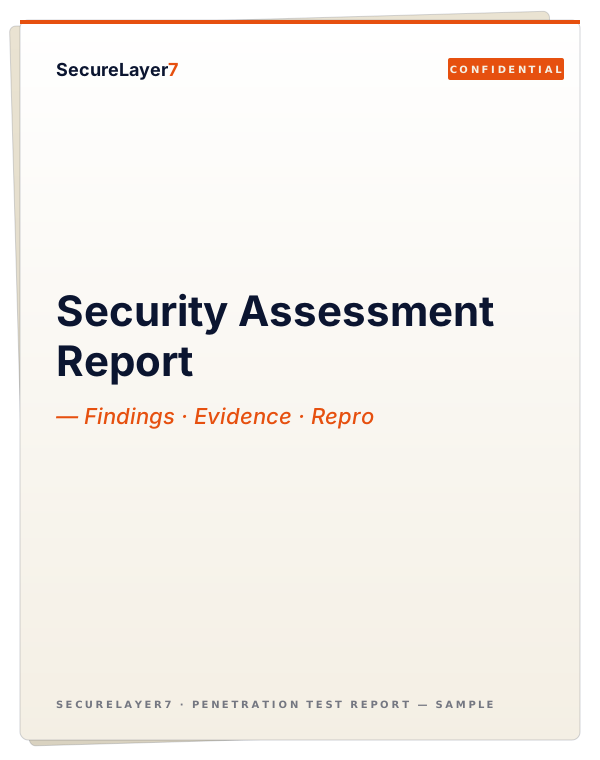
Sample engagement report
See what arrives in your inbox.
A pre-vetted sample report: full kill chain, working prompt-injection PoCs, code-level fix guidance, and re-test scope. Sent on request after a 5-minute scoping call.