
An eye for AI flaws
You can spot the common AI and LLM vulnerabilities in a codebase or a running app, not just name them.
One-day hands-on training · Austin, TX
A practical, one-day AI security training in Austin on finding and fixing the security flaws in AI and LLM applications, taught by the team that tests AI agents for a living.
Price
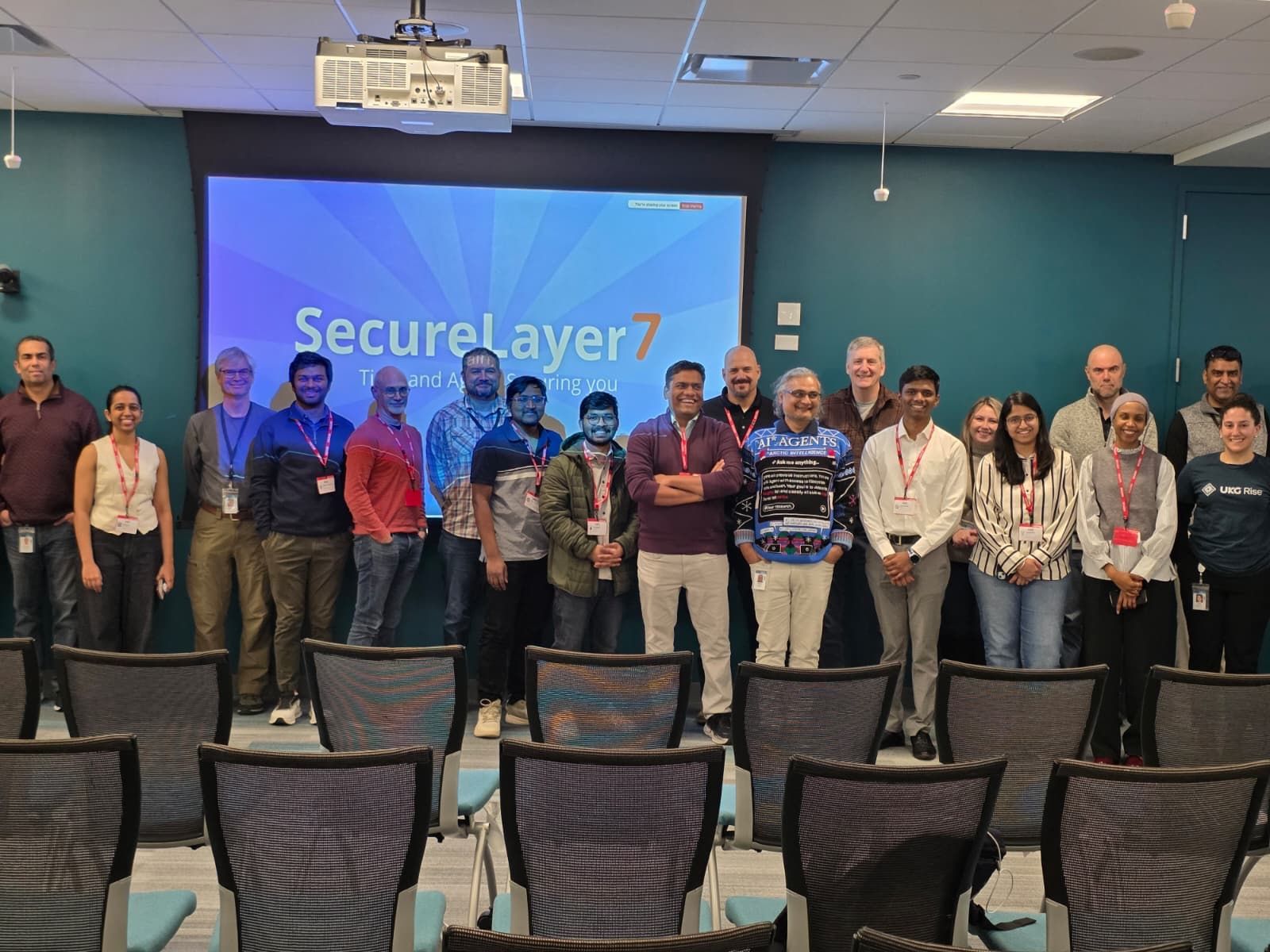
A recent master class
Who it is for
 01
01You build LLM or agent features and want to find the flaws yourself before they reach production.
 02
02You test applications for a living and need AI and LLM attacks in your toolkit, hands-on.
 03
03You are accountable for AI risk and want to see the attacks first-hand so you can guide your team.
What you earn
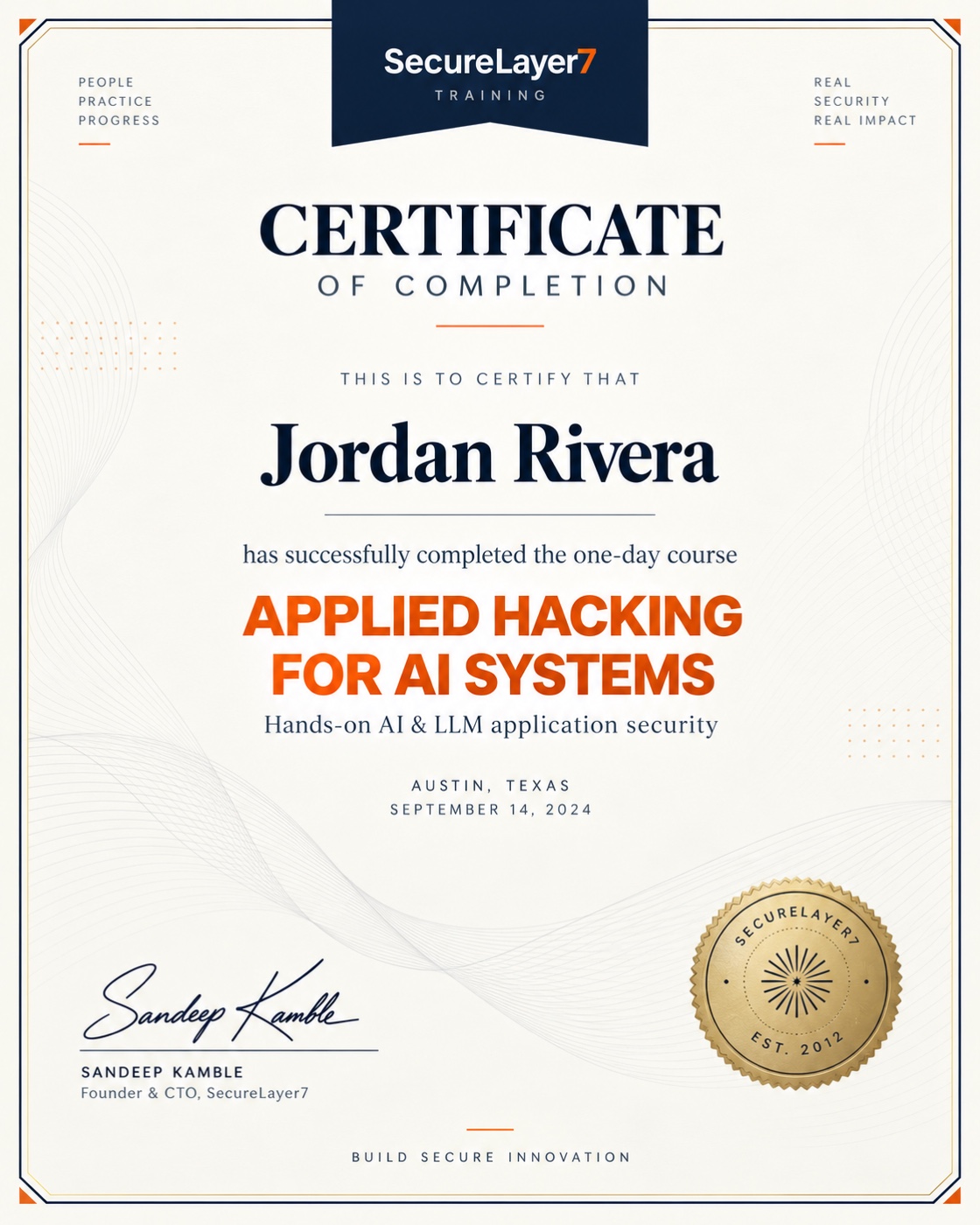
You leave with a certificate of completion for the training, and something harder to put on a slide: the hands-on ability to find and fix the flaws in AI and LLM applications, and a repeatable way to test the ones your own team ships.
The day
You attack a real, deliberately vulnerable AI application through the day, then learn to defend it. Each module pairs a short briefing with a hands-on lab.
How LLM and AI features actually get built and shipped, and where that pipeline breaks. The web flaws that resurface in AI clothing, plus the two maps you use all day: the OWASP Top 10 for LLM applications and MITRE ATLAS.
Before you attack, you map. Where the trust boundaries sit in a real LLM or multimodal deployment, which inputs the model actually trusts, and where one crossed boundary becomes a breach. You threat-model a live, vulnerable app as a group.
Direct and indirect injection: why a model cannot separate your instructions from an attacker’s, and how hidden text in inputs, documents, and tool output takes over its behavior. You run the attacks yourself against public and custom endpoints.
Getting a shipped model to ignore its own guardrails: the bypass patterns that keep working, why they work, and where a jailbreak actually matters once it is wired into an application. Hands-on against real models.
Poisoning what a retrieval system feeds the model, and pulling out the data the app was never meant to reveal. You attack the knowledge layer of a working RAG pipeline.
Excessive agency, tool and connector abuse, and the moment an agent starts doing the attacker’s work with its own access. Lab against an agent wired to real tools and an MCP server.
Unsafe model formats that run code the moment they load, malicious packages posing as AI SDKs, and the open-source models and datasets you inherit without reading. What you can and cannot trust in the AI supply chain.
A repeatable way to red-team your own AI features, scored against the OWASP LLM Top 10 and MITRE ATLAS so findings stay consistent. Then the defenses that hold, and how to tell them from the ones an attacker walks straight through. Capstone lab: attack the full application, then harden it.
Your trainer
Founder & CTO, SecureLayer7
Sandeep is the founder and CTO of SecureLayer7, with fourteen years in offensive security. Most of that has gone into building the offensive tooling behind SecureLayer7’s autonomous pentesting and AI red team work, and under his leadership the team has delivered hundreds of LLM and AI application pentests. He still finds the bugs himself: a remote code execution in n8n, a SQL injection in Spring AI, and fuzzing work against the V8 JavaScript engine, among others. The training comes straight from that work, not from theory, so what you practise in the lab is what actually shows up in the field.

Want this run privately for your team, in Austin or on site? Tell us your goals and we will scope it.
Ask about private trainingBy the end
An eye for AI flaws
You can spot the common AI and LLM vulnerabilities in a codebase or a running app, not just name them.
A way to test your own
A repeatable method to red-team the AI features your team ships, so testing does not stop at the classroom door.
Real attack experience
A full day running real attacks in a safe lab, against an app built to break the way production apps do.
Proof you did it
A certificate of completion, and the confidence to bring this back to your team.
Before you book
Reserve your seat
Seats for the October 21 Austin cohort are limited to keep it hands-on. It is held at the Bull Creek Meeting Room, 1205 Bmc Dr, Cedar Park, TX 78613. Reserve yours.