Server Security HardeningLock the box, then prove it.
Server hardening from SecureLayer7, Linux, Windows, web tier, and database tier locked to a defensible baseline, then probed by hand for the path that survived. SSH key hygiene, sudo policy, kernel sysctl, SMB signing, RDP NLA, web-config audit, DB grant review, every control verified against a working bypass attempt and a re-test.

Four surfaces
Linux · Windows · web tier · database, one engagement, one method, four control planes.
Manual probe
Every benchmark 'PASS' tested for a working bypass, sudo gaps, service-account pivots, DB privilege chains.
Re-test included
We verify your fixes at no extra cost. One engagement, closed loop.
Your CIS benchmark passed in CI, and the live config drifted six weeks ago.
Trusted by security teams across Fintech, SaaS & Education, Enterprise & Telecom, Security & Critical Infrastructure




On record



Why a benchmark isn't a probe
Three controls 'PASS'. The chain still walks.
CIS Benchmarks, STIG checklists, and Lynis runs read your configuration. A live probe reads what an attacker reads, the chain across sudo policy, service accounts, database grants, and kernel capabilities that benchmarks cannot model. SecureLayer7's engagement does both: locks the box to the baseline you'll defend in audit, then probes for the path that survived hardening.

What we harden
Four server surfaces. One engagement.
Each tier is brought to a defensible baseline against its real attack surface, then probed by hand for the path that survived. Intensity tunes per scope.
Linux servers
Ubuntu · Debian · RHEL · CentOS · Alma · Rocky. Kernel sysctl, ssh key & cipher policy, sudo & PAM, /tmp & /var noexec, fail2ban, auditd, AppArmor / SELinux, package-manager hygiene.
Windows Server
Server 2016 / 2019 / 2022. SMB signing, LSA & credential guard, RDP NLA, GPO baseline (CIS / STIG), AppLocker / WDAC, Defender ASR, audit policy, scheduled-task review.
Web servers
Apache · Nginx · IIS · LiteSpeed. server-tokens, mod_status, request limits, TLS / HSTS / OCSP, ModSecurity rule set, .htaccess audit, PHP-FPM pool isolation, fastcgi cache scope.
Databases
MySQL · MariaDB · Postgres · MSSQL · Mongo · Redis. Default-creds review, least-privilege grants, network ACLs, audit logging, backup encryption at rest, secrets-manager binding, replication-account scope.
HARDENING METHODOLOGY.
Eight phases. Baseline to verified patch.
Threat-modelled to your asset inventory, baseline target, and operational risk model. Not a stock checklist run against every host.
- 01
Inventory & threat-model
Host inventory, role classification (web, app, DB, jump, build), blast-radius assumptions defined before any change is made.
- 02
Baseline & drift
Current state measured against CIS, STIG, or vendor baseline. Drift catalogued; per-host exceptions recorded with the reason that justifies them.
- 03
Service & port reduction
Unused services disabled, listening ports closed, optional packages removed. The smallest viable surface that still ships your workload.
- 04
Auth & access hardening
SSH key and cipher policy, sudo and PAM scope, RDP NLA, MFA on admin paths, lockout and session limits, jump-host isolation, break-glass procedure.
- 05
Kernel & runtime hardening
sysctl rules, AppArmor or SELinux profiles, AppLocker or WDAC, /tmp and /var noexec, kernel module restrictions, audit-rule set, log-shipping wired.
- 06
Active probe
Manual exploitation against the hardened state. Sudo gaps, service-account pivots, DB privilege chains, web-config bypass paths. Exercised to credential takeover.
- 07
Remediation guidance
Ansible, DSC, or Puppet snippets; GPO diffs; sysctl rule files; Nginx and Apache config patches. Written for the ops team that runs the fleet, not for the auditor.
- 08
Patch verification
Every finding re-tested after your team ships the fix, at no extra cost. Written confirmation each path is closed.
Insights
Server hardening Resources.
CIS-bench notes, kernel-side findings, and the host-hardening gaps our reviewers see across Linux and Windows fleets.


Meet our expert
One lead hardens every host in scope.
John Dill
vCISO at SecureLayer7
John scopes server-hardening engagements against your fleet inventory, baseline target (CIS, STIG, vendor), and operational risk model. He guides the pod from kick-off through the active-probe walkthrough and the re-test that closes every path.
- Scopes Linux, Windows, web-tier, and database engagements against your real risk model.
- Owns kick-off, mid-engagement check-ins, and live walkthrough of every finding.
- Drives remediation review and re-test until every server-side path is closed.

Ready to scope a server-hardening engagement? Book 30 minutes with John to walk through your fleet, baseline target, and timeline.
Book a 30-min callCommon procurement questions
What buyers ask about server security hardening.
Six questions procurement teams send before signing a hardening engagement SOW. Answered against our methodology and your auditor.
Show all 6 questionsShow less
Have a procurement question not listed here?
Tested by industry.
The bug classes named below come from real engagements in each sector. Pick the closest fit.

Tech SaaS
SaaS production fleet, immutable-image audit, container-host hardening.

FinTech
Banking core servers, HSM-adjacent boxes, regulator-required baseline checks.

HealthTech
EHR application servers, scheduler nodes, HIPAA-baseline configuration.
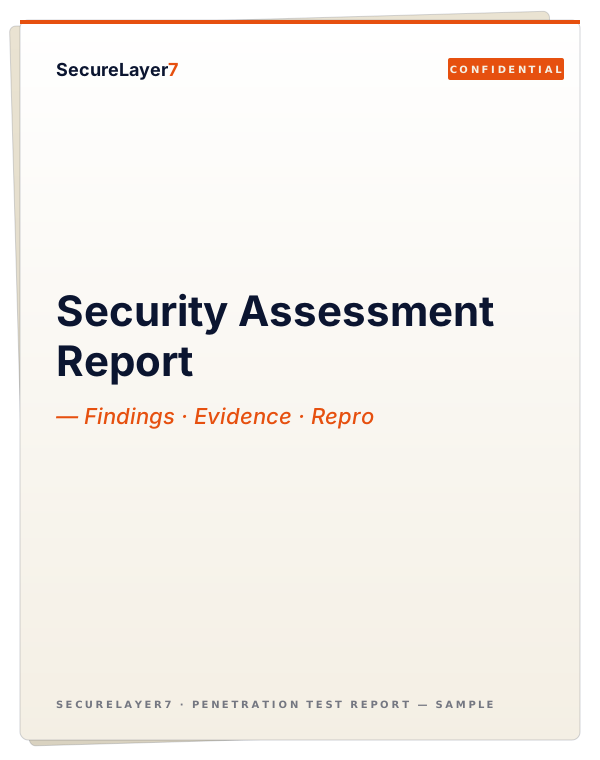
Sample engagement report
See what arrives in your inbox.
A pre-vetted sample report: baseline-vs-probe diff, working bypass narrative, fix scripts ready for Ansible, DSC, or Puppet, and the re-test confirmation. Sent on request after a 5-minute scoping call.