CVE-2026-55677: Echo v5 Encoded Slash Route-Bypass Exposes Static Files
Sending %2F instead of / in a URL tricks Echo's router into skipping auth middleware while the static file handler still decodes and serves the protected file.
The problem
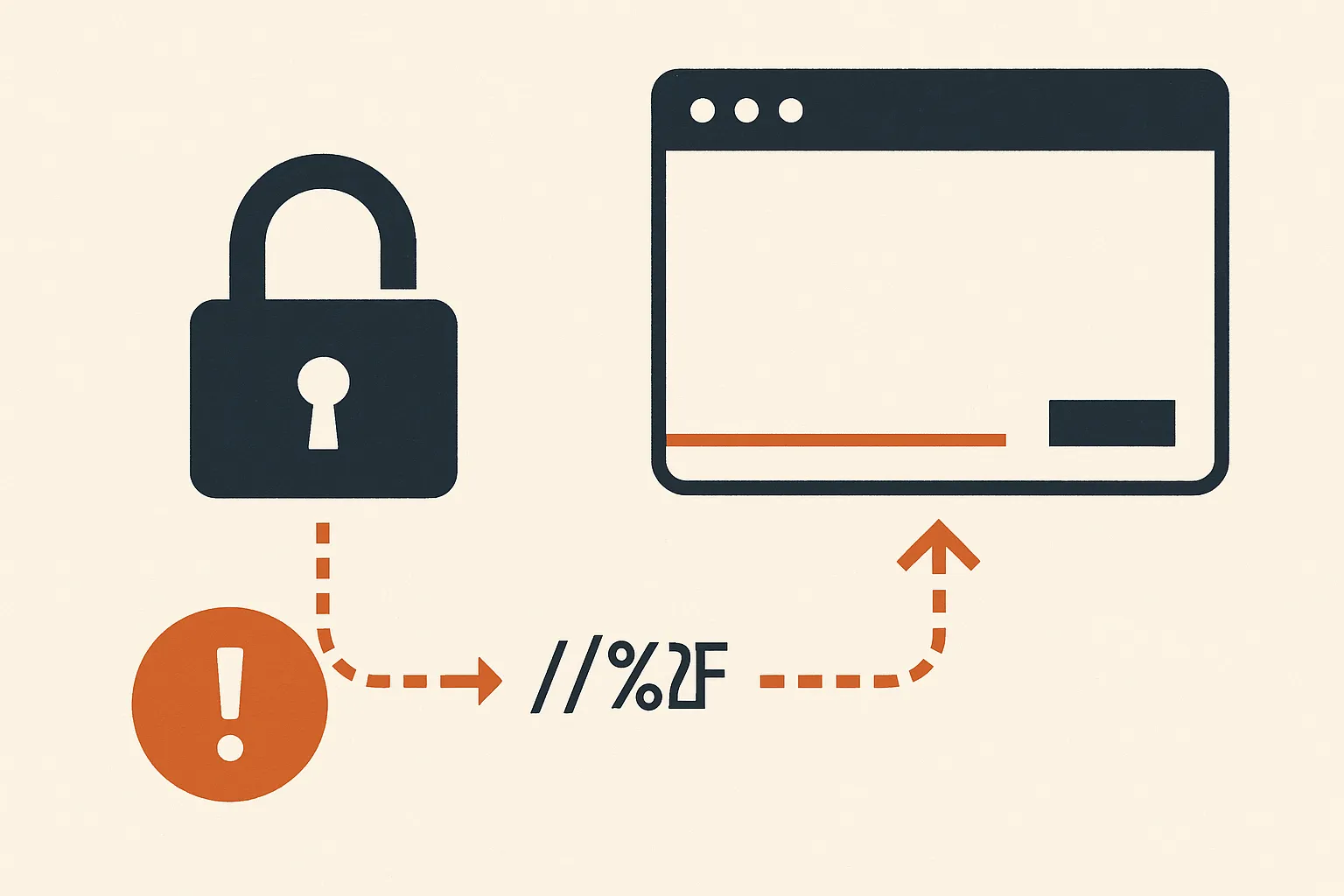
Echo's router and its static file handler process URL encoding differently. The router matches routes against the raw path, so a request like /admin%2Fsecret.txt is treated as a single path segment and never matched against the /admin/* route, meaning any auth middleware on that group is never invoked.
Meanwhile, StaticDirectoryHandler calls url.PathUnescape() on the wildcard param before opening files, converting %2F back to / and serving admin/secret.txt from disk. Any app that guards a route prefix with middleware while serving a broader static root is affected.
Proof of concept
A working proof-of-concept for CVE-2026-55677 in github.com/labstack/echo/v5, with the exact payload below.
GET /admin%2Fsecret.txt HTTP/1.1
Host: target.example.com
The root cause is a decoding split: the router consumes req.URL.RawPath (encoded) for matching, but StaticDirectoryHandler calls url.PathUnescape() on the wildcard param before the filesystem open. This lets %2F act as a router-invisible separator that the filesystem resolves normally.
PR #3009 (v5.2.0) added a check that rejects paths containing encoded separators (%2F, %5C) when EnablePathUnescaping is false. PR #3016 then flipped the default so unescaping is opt-in rather than opt-out, making safe behavior the zero-value configuration.
The fix
Upgrade to github.com/labstack/echo/v5 v5.2.0 or later (v4 users: v4.15.3). After upgrading, path unescaping is disabled by default. Do not set EnablePathUnescaping: true unless your filenames literally contain encoded characters and you are not relying on route-based ACLs.
As a defense-in-depth measure, attach auth middleware directly to the static mount instead of relying on sibling route guards.
Reported by a-tt-om and oran-gugu.
Related research
- highCVE-2026-63445CVE-2026-63445: Perses Filesystem Path Traversal via Unvalidated Project Parameter
- high · 8.8CVE-2026-85731CVE-2026-85731: oras-go Symlink-Chain Path Traversal in tar Extraction
- high · 7.7CVE-2026-69086CVE-2026-69086: SiYuan Attribute-View Path Traversal via Unvalidated avID
- high · 7.7CVE-2026-59832CVE-2026-59832: SiYuan Authenticated Path Traversal in /snippets/ Handler