Thick client application pentesting.Past the network. Into the binary.
Manual thick client application penetration testing across Windows, macOS, Linux native apps plus .NET, Java, and Electron desktop. Tested by hand for DLL-search-order hijacking, named-pipe and XPC ACL abuse, hardcoded keys lifted out of process memory, custom-protocol replay over cleartext, and writable installer paths that escalate to NT AUTHORITY\SYSTEM. Every finding ships with a working proof-of-exploit, code-level fix guidance, and a free re-test.
Native binaries
Windows PE ·.NET · Java desktop · macOS Mach-O · Linux ELF · Electron / Tauri / CEF, every desktop runtime your team ships.
Evidence
Reverse-engineered proof-of-exploit and code-level fix guidance on every finding, Ghidra, Frida, x64dbg artefacts attached.
Re-test included
We verify your fixes at no extra cost. One engagement, closed loop.
The window from vulnerability discovery to exploitation has gone from weeks to hours.
Trusted by security teams across Fintech, SaaS & Education, Enterprise & Telecom, Security & Critical Infrastructure




On record

Why a web pentest can't see this
Web testing stops at HTTP. The risk lives past the boundary.
Your web pentest reaches authentication, session, and the API. The same binary running on a workstation also reaches process memory, named pipes, the registry, the DLL search path, and the kernel. SecureLayer7 operators load your binary into Ghidra and Frida and report the chain that starts where the HTTP scope ends, DLL hijack to SYSTEM, hardcoded key in.data, IPC ACL bypass to a privileged service. Every finding is reproducible, code-level fixable, and re-tested before sign-off.

What we test
Six desktop runtimes. One engagement.
Each runtime gets a manual reverse-engineering pass against its real attack surface, binary on disk, process in memory, IPC channels, and the backend it pairs with. Intensity tunes per scope.
Windows native (PE / COFF)
DLL search-order hijacking, COM hijacking, Authenticode bypass, named-pipe and RPC ACL abuse, service / scheduled-task permission writes, registry hijacks, AppLocker / WDAC bypass, signed-installer write-paths to NT AUTHORITY\SYSTEM.
.NET assemblies
dnSpy / ILSpy round-trip, hardcoded keys and connection strings in /resources, BinaryFormatter and ObjectStateFormatter deserialization gadgets, Json.NET TypeNameHandling abuse, reflection bypass, Strong-Name forgery, ClickOnce manifest tampering.
Java desktop (JAR / JavaFX)
JD-GUI / CFR decompile, signed-JAR replacement, classpath shadowing, Spring / Beanshell injection, JMX management exposure, Java RMI deserialization, native-library (JNI) hijack, hardcoded JDBC credentials in /META-INF.
macOS native (Mach-O)
DYLD_INSERT_LIBRARIES, weak-dylib hijack, codesign and hardened-runtime bypass, XPC service ACL abuse, TCC / privacy-prompt evasion, Keychain ACL misuse, sandbox escape via privileged helpers (SMJobBless, installerd).
Linux native (ELF)
LD_PRELOAD on SUID binaries, RPATH / RUNPATH abuse, .got and .plt write paths, systemd unit override, capability misuse, world-writable shared libraries, D-Bus policy bypass, namespace and cgroup escape.
Electron / Tauri / CEF
ASAR unpack, nodeIntegration leak across renderer-to-main IPC, contextIsolation bypass, custom-protocol handler abuse, autoUpdate signature bypass, Chromium-extension prototype pollution into Node, hardcoded tokens lifted from app.asar.
THICK-CLIENT METHODOLOGY.
Eight phases. Binary to backend protocol.
Threat-modelled to your runtime, your privilege boundary, and the attacker who can drop a binary on a workstation. Not a checklist we run against every desktop app.
Scope & threat-model
Runtime, signing model, IPC channels, privilege boundary, in-scope hosts and supporting services defined before any binary is touched.
Static reverse engineering
Binary disassembled in Ghidra, IDA, or Hopper. Strings, imports, embedded keys, suspicious calls, signing chain, and high-value functions enumerated.
Dynamic instrumentation
Frida, x64dbg, or lldb attached. Function hooking, runtime keylogging of cleartext secrets, traffic interception under TLS-pinning bypass, GUI-flow control.
IPC & privilege mapping
Named pipes, COM, XPC, D-Bus, RPC, sockets, registry hooks, and on-disk handoff paths exercised against the privilege boundary.
Local privilege escalation
DLL hijacking, ACL misuse on writable folders, service and scheduled-task abuse, weak-dylib search, LD_PRELOAD on SUID. Pushed to NT AUTHORITY\SYSTEM, root, or _securityd.
Network & backend pairing
Custom protocols decoded, server-side auth bypassed when client checks are forged, replay and MITM exercised against the binary's real backend.
Remediation guidance
Code-level fixes, Authenticode and notarization tightening, ACL diffs, secret-storage migration, IPC policy snippets. Written for the team that built the app.
Patch verification
Every finding re-tested after your team ships the fix, at no extra cost. Written confirmation each path is closed.
Insights
Thick-client Resources.
Notes from desktop and Electron reviews: IPC abuse, local-storage drift, and binary-side bugs that web scanners never reach.
Meet our expert
One lead, binary to backend in scope.
Nivedita Singh
Security Advisor & Engagement Lead
10+
Years in offensive security
300+
Engagements led
99.7%
On-time delivery rate
Nivedita scopes thick-client engagements against your runtime, signing model, and privilege boundary. She guides the pod from kick-off through final report and re-test.
- Scopes Windows, macOS, Linux, and cross-platform desktop engagements against your real privilege model.
- Owns kick-off, mid-engagement check-ins, and a live walkthrough of every finding with a working PoC.
- Drives remediation review and re-test until every binary-path finding is closed.

Ready to scope a thick-client pentest? Book 30 minutes with Nivedita to walk through your runtime, scope, and timeline.
Tested by industry.
The bug classes named below come from real engagements in each sector. Pick the closest fit.


HealthTech
EHR thick clients, imaging-viewer workstations, lab analyzer software.

Tech SaaS
Internal admin tools, on-premise SaaS clients, partner-installed applets.
Built for Saudi Arabia engagements
What changes when we deliver here.
Compliance scoping
NCA ECC 2-3 endpoint sub-control citation per finding
Regulatory framework
SAMA endpoint-protection wording in the deliverable
Local engagements
Dammam trading-desk client closed 9 binary findings before SAMA audit
Local pricing
SAR per-binary scoping with VAT 15% itemised
Compliance scoping
PDPL memory-leak personal-data flagging
Thick client questions from KSA security teams.
Do findings line up with NCA ECC 2-3 endpoint controls?
Yes. Each issue cites the ECC 2-3 sub-control. NCA reviewers trace from binary behaviour to control wording without effort.
Will SAMA endpoint reviewers accept the report?
Yes. Findings format to SAMA endpoint-protection language. Bank desktop-fleet auditors sign off without re-templating.
How is reverse engineering handled under PDPL?
Binaries and memory dumps sit on KSA-region storage. Any personal data found in memory is flagged against the PDPL Article that fits.
Do you cover hardware-token and smartcard flows?
Yes. PKI cards used by Saudi banks and government are tested for cert pinning, PIN handling, and middleware abuse.
Delivery in Saudi Arabia
Desktop app testing aligned to NCA ECC 2-3.
Windows and .NET binaries are tested against NCA ECC 2-3 endpoint and SAMA endpoint-protection guidance. SAR-denominated, KSA-region binary handling.
- Direct line
- +966-11-000-0000
- Office
- Riyadh, Saudi Arabia
Frameworks scoped: NCA ECC · SAMA CSF · PDPL · ISO/IEC 27001.
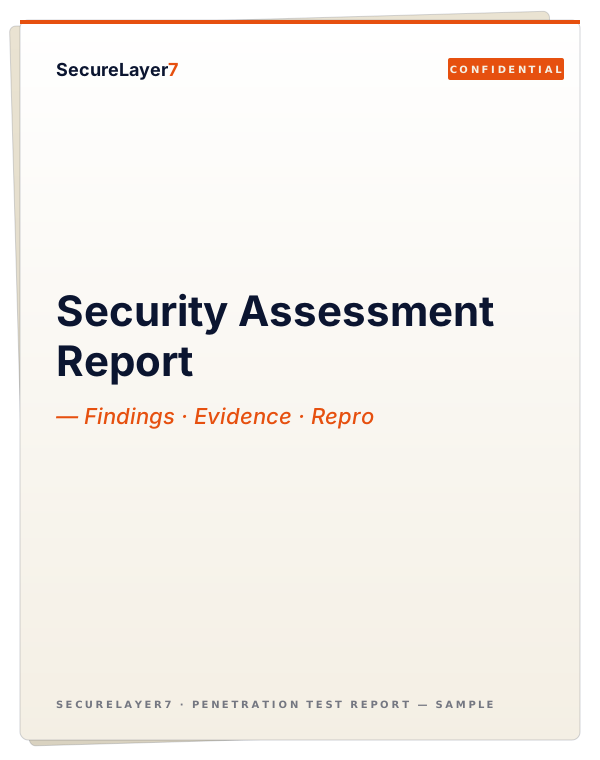
Sample engagement report
See what arrives in your inbox.
A pre-vetted sample report: full vulnerability narrative, working proof-of-exploit, code-level fix guidance. Sent on request after a 5-minute scoping call.