Web Application Penetration Testing in IndiaCERT-In empanelled. Reports mapped to RBI CSF and SEBI CSCRF.
SecureLayer7 is one of roughly 150 CERT-In empanelled firms authorised by the Government of India. We run web application pentests for Indian banks, NBFCs, capital market intermediaries, and BFSI fintechs. Engagement terms governed by Indian law, evidence packs your RBI, SEBI, and IRDAI auditors accept on first review.

Full attack surface coverage
Authentication, business logic, API endpoints, session management, not just OWASP Top 10.
Working proof-of-exploit
Every finding includes a reproducible PoC and video, developer-ready, not just a CVSS score.
Re-test included
We verify your fixes at no extra cost. One engagement, closed-loop, not a revolving invoice.
The window from vulnerability discovery to exploitation has gone from weeks to hours.
Trusted by security teams across Fintech, SaaS & Education, Enterprise & Telecom, Security & Critical Infrastructure




Scope
Every attack surface. Not just OWASP Top 10.
Authentication, authorisation, business logic abuse, API misuse, and session handling, tested against the threat patterns CERT-In and the RBI Cybersecurity Cell flag most often in Indian incidents.
Authentication & Session
Login bypass, session fixation, token prediction, password reset flaws, MFA weaknesses.
Business Logic Flaws
Price manipulation, privilege escalation, workflow abuse, unique to your application.
API & GraphQL
REST and GraphQL endpoints, mass assignment, IDOR, broken object-level authorization.
Injection & Execution
SQLi, XXE, SSTI, command injection, deserialization, tested manually with chained exploits.
Client-Side Attacks
XSS, CSRF, clickjacking, postMessage abuse, DOM-based vulnerabilities.
Infrastructure & Config
Exposed admin panels, misconfigured headers, verbose error messages, third-party components.
How we pentest
Every finding verified. Eight phases, closed-loop.
Threat-modelled to the attack patterns Indian regulators see most: payment fraud via UPI rail abuse, credential stuffing against Indian banking mobile apps, OAuth scope abuse in fintech APIs, and unauthorised access in capital market trading platforms.
Reconnaissance & Enumeration
We map your real attack surface, subdomains, exposed endpoints, tech stack, third-party integrations, and anything a motivated attacker would find before engaging.
Scoping & Threat Modelling
We build a threat model specific to your application, not a generic checklist. High-value targets, user roles, and probable attacker paths are defined before a single test runs.
Static Analysis
Client-side code, JavaScript bundles, and API schemas are reviewed for logic leaks, hardcoded secrets, and insecure patterns that dynamic testing alone won't surface.
Dynamic Analysis
Active testing against your running application, authentication bypass, session hijacking, input fuzzing, and flow abuse that requires a human attacker, not a scanner.
App & API Analysis
Every REST and GraphQL endpoint tested for IDOR, mass assignment, broken object-level auth, rate limiting gaps, and injection, with chained exploit scenarios, not isolated CVEs.
Vulnerability Analysis
Findings are correlated, chained into real exploit paths, and assigned CVSS scores with business impact context, so your team knows what to fix first and why.
Remediation Guidance
Remediation guidance written for developers, not auditors. Code-level fix examples, library recommendations, and configuration changes, not a list of CWEs to Google.
Patch Verification
Every finding is re-tested after your team ships fixes, at no extra cost. You get written confirmation that each vulnerability is resolved, not just closed on a spreadsheet.
Deliverables
A report your auditor accepts. Your developers can act on.
Reports written for Indian regulators. RBI Cybersecurity Framework gap mapping, SEBI CSCRF v2 control coverage, DPDP Act 2023 personal-data-breach readiness, ISO/IEC 27001 audit input. Every finding ships with a working PoC and code-level fix guidance.
CREST-accredited. Accepted by:



Reproducible PoC + Video
Every finding ships with a working exploit and screen recording. Your developers see exactly what an attacker sees, no guesswork, no chasing us for clarification.
Code-Level Fix Guidance
Remediation written for engineers, not auditors. Specific code changes, library recommendations, and config fixes, not a list of CWEs to Google.
Re-test Included
Every finding is re-tested once your team ships the fix, at no extra cost. One engagement, closed loop. You get written confirmation, not just a closed ticket.
Compliance-Ready Report
CREST-accredited report accepted by SOC 2, ISO 27001, PCI DSS, and HIPAA auditors out of the box. No re-scoping, no addenda, no extra calls with your audit team.
Accreditations


Built for India engagements
What changes when we deliver here.
Compliance scoping
CERT-In empanelled, one of roughly 150 firms authorised by Govt of India
Regulatory framework
DPDP Act 2023 readiness mapping baked into scope
Compliance scoping
RBI CSF + SEBI CSCRF v2 coverage for BFSI clients
Local engagements
India clients: Razorpay, Bankit, and BFSI startups across Pune and Mumbai
Local pricing
INR-denominated pricing, GST-compliant invoicing
Questions Indian security buyers ask first.
Is your CERT-In empanelment current?
Yes. Empanelment is current through the 3-year cycle. The number prints on every engagement letter, and RBI and SEBI auditors verify against the CERT-In published list.
Are findings accepted by RBI as part of annual cybersecurity audits?
Yes. Reports follow RBI's 2016 Master Direction inspection format. Methodology, scope, and findings align. Covers both Master Direction for banks and the IT Framework for NBFCs.
How do you support SEBI CSCRF v2 compliance for capital market intermediaries?
SEBI CSCRF v2 (Aug 2024) requires annual pentests for brokers, depositories, and KRAs. Our methodology covers the control families inspectors flag most: Identify-2, Protect-1, and Detect-1.
What about DPDP Act 2023 readiness for personal data handling?
Every finding carries a DPDP Section 8 impact note. Chains reaching personal data flag as Section 9 notifiable-breach precursors, with rationale ready for your DPO.
Delivery in India
CERT-In empanelled. RBI-aligned. INR-denominated.
CERT-In empanelment number printed on every engagement letter. Reports formatted to RBI Master Direction and SEBI CSCRF v2 templates. INR quotes, GST-compliant invoicing.
- Direct line
- +91-20-71600505
- Office
- Pune, Maharashtra, India
Frameworks scoped: CERT-In · DPDP Act · RBI CSF · SEBI CSCRF · ISO 27001 · PCI DSS.
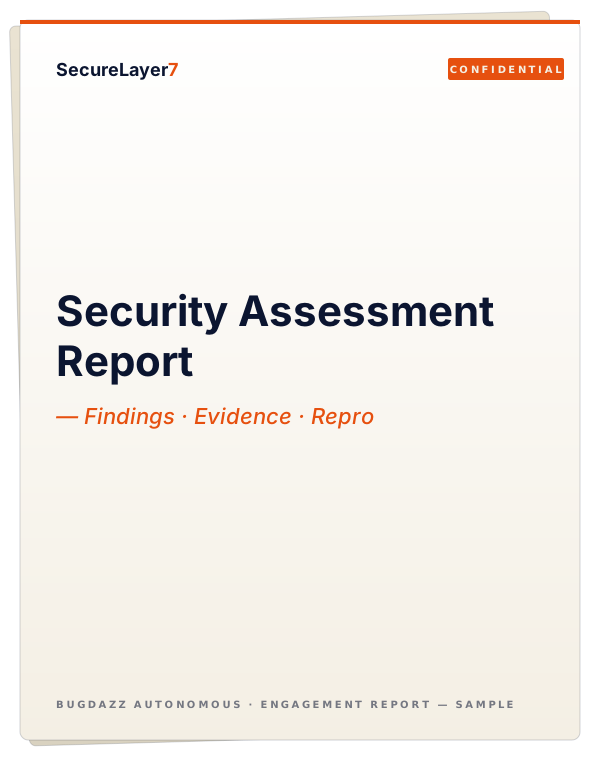
See What a Finding Actually Looks Like
Our sample report shows a real WAPT engagement, working PoC, code-level fix guidance, and the CREST-accredited format your auditors expect.