Network penetration testing
Find what a vuln scan never reaches.
External · Internal · Wireless · Devices, tested by hand for SMB-signing NTLM relay, mitm6 + WPAD coercion, kerberoastable service accounts, ADCS ESC1 template abuse, EAP/WPA2-Enterprise misconfig, and exposed firewall management. Every finding lands with the captured ticket, the relayed session, the cracked hash, and the GPO or ACL diff your team can ship.
Four surfaces
External · Internal · Wireless · Devices, one method, four entry points.
Evidence
Captured tickets, relayed sessions, cracked hashes, not screenshots of a scanner.
Re-test included
We verify your fixes at no extra cost. One engagement, closed loop.
NAC bypass, VLAN hop, AD CS abuse, internal compromise from a guest port in under an hour.
Trusted by security teams across Fintech, SaaS & Education, Enterprise & Telecom, Security & Critical Infrastructure




On record




Why a vuln scan isn't a pentest
An open port is not domain admin.
A scanner reports SMB signing optional, IPv6 enabled, a service account with a SPN. SecureLayer7's operators take it further, relay the next workstation auth into a privileged share, run mitm6 against the IPv6 stack to coerce DC$ to authenticate, kerberoast the SPN and crack it offline. Every finding ships with the captured ticket, the relayed session, and the GPO or registry diff your engineers can deploy.
IN SCOPE.
What lands in a network engagement.
Exposed services, expired certs, forgotten subdomains, third-party connectors with weak trust.
Kerberoasting, AS-REP, ACL abuse, ADCS templates, GPO ownership. Map to Domain Admin.
Lateral routes the firewall ruleset doesn't see. Server VLAN to OT, DMZ to user, prod to dev.
DNS tunnels, C2 channels through allowed proxies, SSL-inspection gaps, egress to attacker infra.
INTERNAL NETWORK COVERAGE.
What 200+ internal chains decompose into when we run a real test.
- 01Guest port to domain user
NAC bypass via MAC spoof on a printer VLAN, then LLMNR poisoning with Responder to capture NTLMv2 hashes.
- 02NTLM relay to ADCS
Coerce auth with PetitPotam or PrinterBug, relay to Active Directory Certificate Services ESC8 web enrollment for a domain admin cert.
- 03Kerberoasting to service account
Request service tickets for SPN-bound accounts, crack the RC4 hash offline, reuse the password against linked SQL boxes.
- 04mitm6 to DNS takeover
Spoof DHCPv6 with mitm6, become the IPv6 DNS server, relay WPAD-triggered auth into LDAPS for domain object writes.
- 05LAPS read to local admin
Abuse a misconfigured ACL on ms-Mcs-AdmPwd to pull plaintext local administrator passwords across a tier-2 fleet.
- 06Segmentation hop to OT
Find a flat path from corporate Wi-Fi to the OT VLAN through a forgotten jump host with exposed RDP and reusable creds.
What we test —
Four network surfaces. One engagement.
Each boundary gets a manual, threat-modelled review against its real attack surface — perimeter, AD-joined estate, wireless edge, and the devices that route between them. Intensity tunes per scope.
External — internet-facing
Subdomain takeover, exposed RDP/SSH/SMB, vendor-portal SSRF, VPN-appliance CVE chains, perimeter mail-relay abuse, exposed git/CI endpoints, ASN-wide cert-transparency mining, and credential-leak correlation against the perimeter login surface.
Internal — east-west + AD
SMB-signing NTLM relay, kerberoasting and AS-REProasting, mitm6 + WPAD coercion, ADCS ESC1–ESC8 abuse, LAPS-password reuse, Group Policy preference passwords, BloodHound-mapped attack paths to Domain Admin and Tier-0 hosts.
Wireless — Wi-Fi + 802.1X
WPA2/WPA3 handshake capture and crack, EAP-TLS cert-pinning bypass, PEAP/MSCHAPv2 relay, rogue-AP and KARMA, 802.1X NAC bypass via MAC spoof, guest-network pivot, captive-portal credential harvest.
Devices — firewalls, switches, routers
Exposed management interfaces (SSH/HTTPS/SNMP), default and stale credentials, ACL bypass via spoofed source, SNMPv2 community brute-force, IPv6-routing override, firmware-CVE pivot to lateral access.
NETWORK PENTEST METHODOLOGY.
Eight phases. Perimeter to Domain Admin.
Threat-modelled to your perimeter, AD topology, segmentation, and admin-tier model. Not a template we run against every network.
- 01
Scope & threat-model
In-scope CIDRs, AD forests, wireless SSIDs, and admin tiers agreed in writing before any traffic. Out-of-scope DR sites, partner ASNs, and legal-blocked targets recorded.
- 02
Recon & enumeration
ASN and cert-transparency sweep on the perimeter, BloodHound and PingCastle on the internal estate, wireless RF survey for in-scope SSIDs, SNMP or SSH banner inventory on devices.
- 03
External exploitation
Vendor-portal SSRF, exposed admin interfaces, VPN-appliance CVE chains, mail-relay abuse, leaked-credential password-spray. Exercised to first foothold inside the perimeter.
- 04
AD exploitation
NTLM relay across SMB-signing-off hosts, mitm6 with WPAD coercion, kerberoast and AS-REProast, ADCS ESC chains, LAPS reuse, Group Policy preference passwords. Pursued to Domain Admin or Tier-0.
- 05
Wireless & edge
Handshake capture and crack, EAP or PEAP relay, rogue-AP and KARMA, 802.1X bypass via MAC spoof, captive-portal harvest. Measured to a routable session inside the corporate VLAN.
- 06
Vulnerability analysis
Findings correlated, chained into attack paths, scored against your real network blast-radius. Your team sees what's reachable, not just what's exposed.
- 07
Remediation guidance
GPO snippets, ADCS template diffs, firewall ACL changes, switch port-security configs, AD tiering recommendations. Written for network and AD engineers, not auditors.
- 08
Patch verification
Every finding re-tested after your team ships the fix, at no extra cost. Written confirmation each path is closed.
Insights
Network security Resources.
Field notes on segmentation drift, AD path abuse, and the internal-network bugs that scanners miss.


Meet our expert
Meet our expert
John Dill
vCISO at SecureLayer7
15+
Years in offensive security
150+
Engagements led to date
99.99%
On-time engagement delivery
John scopes network pentest engagements against your perimeter, AD topology, wireless footprint, and admin-tier model. He guides the pod from kick-off through final report and re-test.
- Scopes external, internal, wireless, and device-layer engagements against your real risk model.
- Owns kick-off, mid-engagement check-ins, and live walkthrough of every captured ticket and relayed session.
- Drives remediation review and re-test until every attack path is closed.

Ready to scope a network pentest? Book 30 minutes with John to walk through your perimeter, AD model, and timeline.
Book a 30-min callCommon procurement questions
What buyers ask about network penetration testing.
Six questions procurement teams send before signing a network pentest SOW. Answered against our methodology and your auditor.
Show all 6 questionsShow less
Have a procurement question not listed here?
Tested by industry.
The bug classes named below come from real engagements in each sector. Pick the closest fit.

Tech SaaS
SaaS production networks, segmentation between dev/stage/prod, VPN paths.


Sample engagement report
See what arrives in your inbox.
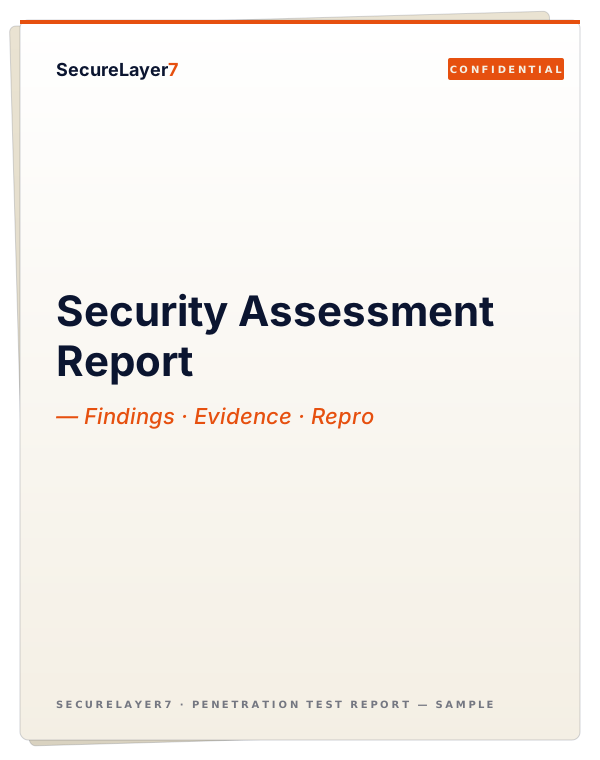
A pre-vetted sample report: full attack-path narrative, captured ticket, relayed session, and the GPO or ACL diff your engineers can deploy. Sent on request after a 5-minute scoping call.