Web Application Penetration TestingThat Tells You What's Actually at Risk.
Web application penetration testing services from SecureLayer7 are a manual, researcher-led assessment of your application's authentication, business logic, session handling, and APIs. Testers chain individual flaws into a working proof-of-exploit, then hand back auditor-ready evidence per phase. Every engagement includes a free retest after you ship the fixes.
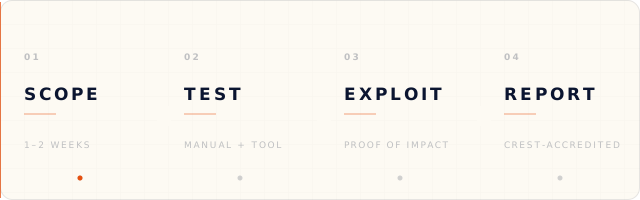
Full attack surface coverage
Authentication, business logic, API endpoints, session management, not just OWASP Top 10.
Working proof-of-exploit
Every finding includes a reproducible PoC and video, developer-ready, not just a CVSS score.
Re-test included
We verify your fixes at no extra cost. One engagement, closed-loop, not a revolving invoice.
Window from vulnerability discovery to exploitation has gone from weeks to hours.
Trusted by security teams across Fintech, SaaS & Education, Enterprise & Telecom, Security & Critical Infrastructure




Scope
Every attack surface. Not just OWASP Top 10.
Most pentests are a scanner with a human in front of it. Ours aren't. We test auth flows, business logic, API abuse, session management, and chained attack paths, the vulnerabilities that automated tools cannot find.
Authentication & Session
Login bypass, session fixation, token prediction, password reset flaws, MFA weaknesses.
Business Logic Flaws
Price manipulation, privilege escalation, workflow abuse, unique to your application.
API & GraphQL
REST and GraphQL endpoints, mass assignment, IDOR, broken object-level authorization. See the dedicated API pentest page for the full scope.
Injection & Execution
SQLi, XXE, SSTI, command injection, deserialization, tested manually with chained exploits.
Client-Side Attacks
XSS, CSRF, clickjacking, postMessage abuse, DOM-based vulnerabilities.
Infrastructure & Config
Exposed admin panels, misconfigured headers, verbose error messages, third-party components.
Accreditations



BY THE NUMBERS.
The chain classes a generic web scan never reports.
- 01Auth bypass to admin
JWT alg none, signature stripped, kid header path-traversal, second-order role claim trusted on the resource server.
- 02Business-logic abuse
Coupon stacking, negative-quantity orders, refund races, account merge that inherits the higher-tier permissions.
- 03File upload to RCE
MIME-only check, polyglot file, path-traversal in the filename, write into a directory the application server executes from.
- 04SSTI to shell
Jinja2 or Freemarker template fed user input, sandbox escape via __class__ chain, host process command execution.
- 05GraphQL introspection abuse
Introspection on in production, alias-based query batching defeats rate limits, depth-recursion turns one request into a DoS.
- 06Session fixation chain
Session id accepted in URL, no rotation on auth, OAuth callback that preserves the pre-login cookie. Anonymous to authenticated victim.
HOW WE PENTEST.
Every finding verified. Eight phases, closed-loop.
Threat-modeled to your application's user roles, data flows, and business logic. Not a template we run against every engagement.
Recon & enumeration
Map your real attack surface: subdomains, exposed endpoints, tech stack, third-party integrations, and anything a motivated attacker would find before engaging.
Scope & threat-model
Build a threat model specific to your application, not a generic checklist. High-value targets, user roles, and probable attacker paths defined before a single test runs.
Static analysis
Client-side code, JavaScript bundles, and API schemas reviewed for logic leaks, hardcoded secrets, and insecure patterns that dynamic testing alone won't surface.
Active testing
Against your running application: authentication bypass, session hijacking, input fuzzing, and flow abuse that requires a human attacker, not a scanner.
App & API analysis
Every REST and GraphQL endpoint tested for IDOR, mass assignment, broken object-level auth, rate-limiting gaps, and injection. Chained exploit scenarios, not isolated CVEs.
Vulnerability analysis
Findings correlated, chained into real exploit paths, assigned CVSS scores with business impact context. Your team knows what to fix first and why.
Remediation guidance
Written for developers, not auditors. Code-level fix examples, library recommendations, and config changes. Not a list of CWEs to Google.
Patch verification
Every finding re-tested after your team ships fixes, at no extra cost. You get written confirmation each vulnerability is resolved, not just closed on a spreadsheet.
BugDazz, Continuous Penetration Testing Platform
No spreadsheets. No status emails. BugDazz handles the admin.
Every finding lands in your Jira, Slack, or ServiceNow the moment it is confirmed. Re-tests are tracked automatically. Your team spends time fixing, not chasing the consultant.
See how BugDazz worksFindings flow into your tools
Every confirmed vulnerability lands in Jira, Slack, or ServiceNow the moment it's flagged, no waiting for an end-of-engagement PDF.
Re-tests tracked automatically
When your team marks a fix as shipped, BugDazz queues the re-test automatically. No back-and-forth. No missed verifications. Every fix gets confirmed before the engagement closes.
Written sign-off on every fix
Every remediated finding gets tester sign-off. Your auditor sees reported → fixed → verified, not just a closed ticket.
Connects to your existing stack
Jira, Slack, ServiceNow, GitHub, PagerDuty, Confluence, BugDazz integrates where your team already works. No new tools to adopt.
Deliverables
A report your auditor accepts. Your developers can act on.
Every finding is complete, working proof-of-exploit, code-level fix guidance, and a re-test to confirm the patch. The report itself is CREST-accredited and accepted by SOC 2, ISO 27001, PCI DSS, and HIPAA auditors. Hand it to your auditor without a second round of questions.
CREST-accredited. Accepted by:

Reproducible PoC + Video
Every finding ships with a working exploit and screen recording. Your developers see exactly what an attacker sees, no guesswork, no chasing us for clarification.
Code-Level Fix Guidance
Remediation written for engineers, not auditors. Specific code changes, library recommendations, and config fixes, not a list of CWEs to Google.
Re-test Included
Every finding is re-tested once your team ships the fix, at no extra cost. One engagement, closed loop. You get written confirmation, not just a closed ticket.
Compliance-Ready Report
CREST-accredited report accepted by SOC 2, ISO 27001, PCI DSS, and HIPAA auditors out of the box. No re-scoping, no addenda, no extra calls with your audit team.
Insights
Web application Resources.
Field notes from our application pentest pod: chained authn/authz bugs, CVE write-ups, and what our reviewers flag before a release ships.
AI in our engagements
Where AI runs. Where a human signs.
AI accelerates recon, surface mapping, and report drafting. CREST-accredited researchers chain the exploit and sign every finding. We publish the handoff per phase so your auditor can read it.
Meet our expert
Nivedita Singh
Security Advisor & Engagement Lead
10+
Years in application security
300+
WAPT engagements led
99.7%
On-time delivery rate
Nivedita scopes web-application engagements against your architecture and risk priorities. She guides the pod from kick-off through final report and re-test.
- Scopes web, API, and SaaS-tenant engagements against your real risk model.
- Owns kick-off, mid-engagement check-ins, and live walkthrough of every finding.
- Drives remediation review and re-test until every finding is closed.

Ready to scope a web-application pentest? Book 30 minutes with Nivedita to walk through your stack, scope, and timeline.
Common procurement questions
What buyers ask about web application pentests.
Six questions procurement teams send before signing a WAPT SOW. Answered against our methodology and your auditor.
Show all 7 questionsShow less
Have a procurement question not listed here?
For startups
Pre-Series A? Apply for the startup program.
A single Autonomous app pentest, CREST-aligned report, engagement-lead signoff, retest included, heavily discounted for pre-Series A startups passing enterprise procurement or SOC 2 due diligence. Eligibility verified on application.
Tested by industry.
The bug classes named below come from real engagements in each sector. Pick the closest fit.



Tech SaaS
Multi-tenant SaaS web surfaces, admin consoles, customer-facing dashboards.
Sample engagement report
See what a finding actually looks like.
A real WAPT sample: working PoC, code-level fix guidance, and the CREST-accredited format your auditors expect.