Cloud penetration testing
Find what config audits miss.
AWS · Azure · GCP · Kubernetes, tested by hand for IMDSv1 SSRF, IAM role-chain abuse, managed-identity over-scope, workload-identity confusion, and pod-to-host RBAC bypass. Every finding lands with a working proof-of-exploit, code-level fix guidance, and a re-test.
Four providers
AWS · Azure · GCP · Kubernetes, one method, four control planes.
Evidence
Working proof-of-exploit and code-level fix guidance on every finding.
Re-test included
We verify your fixes at no extra cost. One engagement, closed loop.
A single over-permissive IAM role escalates to org-wide blast radius.
Trusted by security teams across Fintech, SaaS & Education, Enterprise & Telecom, Security & Critical Infrastructure




On record


Why a config audit isn't a pentest
A finding flagged is not a finding proven.
CSPM tools and checklists report what your cloud looks like. A pentest reports what an attacker can do with it. SecureLayer7's operators chain those flagged findings, IMDSv1 enabled, Lambda role attached, pod runs as root, into the proof-of-exploit your engineers can fix and your auditor will accept.

IN SCOPE.
Four reading frames across your cloud.
Provider-agnostic engagement: AWS, Azure, GCP, or a multi-cloud estate.
Assume-role paths, SSO trust, third-party connectors. One identity, every account it reaches.
Container, function, VM boundaries. Read the metadata service, ride the IMDS token outward.
Bucket policies, snapshot lineage, KMS key sharing, cross-region replication left open.
VPC peering, private link, transit gateway, service mesh. Hops the config audit doesn't trace.
What we test —
Four cloud surfaces. One engagement.
Each provider gets a manual, threat-modelled review against its real attack surface — control plane, identity, network, and workload. Intensity tunes per scope.
Amazon AWS
IMDSv1 SSRF, IAM role chaining, public S3 enumeration, Lambda over-privilege, EKS cluster-role abuse, KMS key-policy misuse, Cognito user-pool misconfig, Secrets Manager exposure.
Microsoft Azure
Managed identity over-scope, Storage Account SAS leak, Function App env exposure, AKS pod-identity abuse, Key Vault access policy bypass, Azure AD application consent, Logic App secret reuse.
Google Cloud Platform
Workload-identity confusion, service-account impersonation, Cloud Run scope abuse, GKE node pool escape, Secret Manager IAM gaps, Cloud Storage bucket policy bypass, Cloud Functions trigger replay.
Kubernetes
Pod escape via privileged container, RBAC bypass, etcd exposure, kubelet API abuse, sidecar/init container attack paths, NetworkPolicy gaps, admission-controller bypass, ServiceAccount token theft.
CLOUD PENTEST METHODOLOGY.
Eight phases. Control plane to workload.
Threat-modelled to your control plane, identity model, and workload topology. Not a template we run against every cloud.
- 01Scope & threat-model
- 02Recon & enumeration
- 03Configuration review
- 04Identity exploitation
- 05Workload & network exploitation
- 06Vulnerability analysis
- 07Remediation guidance
- 08Patch verification
Insights
Cloud security Resources.
Cross-provider attack-path notes: AWS, Azure, GCP, written by the same reviewers who run cloud pentests.


Meet our expert
Meet our expert
Nivedita Singh
Security Advisor & Engagement Lead
10+
Years in offensive security
300+
Engagements led
99.7%
On-time delivery rate
Nivedita scopes cloud-pentest engagements against your account topology, identity model, and workload boundaries. She guides the pod from kick-off through final report and re-test.
- Scopes AWS, Azure, GCP, and Kubernetes engagements against your real risk model.
- Owns kick-off, mid-engagement check-ins, and live walkthrough of every finding.
- Drives remediation review and re-test until every cloud-path finding is closed.

Ready to scope a cloud pentest? Book 30 minutes with Nivedita to walk through your topology, identity model, and timeline.
Common procurement questions
What buyers ask about cloud penetration testing.
Six questions procurement teams send before signing a cloud pentest SOW. Answered against our methodology and your auditor.
Show all 6 questionsShow less
Have a procurement question not listed here?
For startups
Pre-Series A? Apply for the startup program.
A single Autonomous app pentest, CREST-aligned report, engagement-lead signoff, retest included, heavily discounted for pre-Series A startups passing enterprise procurement or SOC 2 due diligence. Eligibility verified on application.
Tested by industry.
The bug classes named below come from real engagements in each sector. Pick the closest fit.


FinTech
Cloud-native banking workloads, KMS / HSM boundaries, settlement isolation.

Retail
E-commerce on cloud, POS sync APIs, customer-PII surfaces in serverless paths.
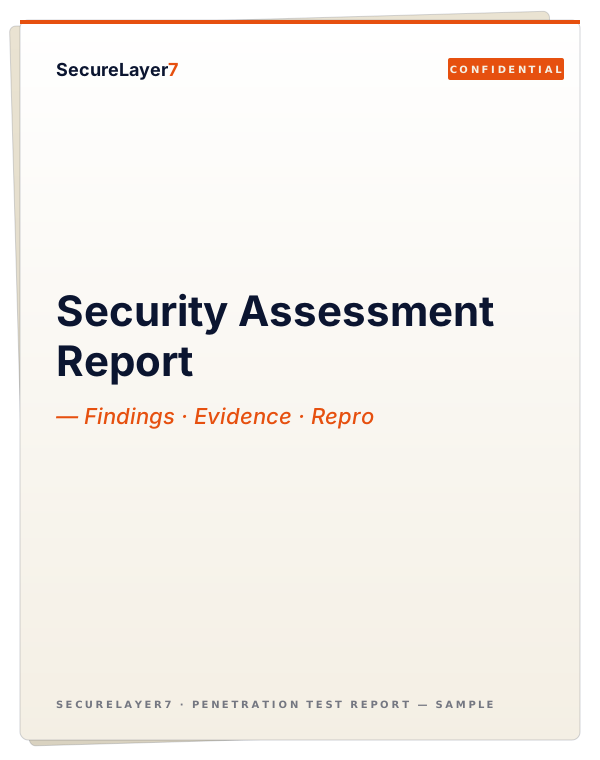
Sample engagement report
See what arrives in your inbox.
A pre-vetted sample report: full vulnerability narrative, working PoC, code-level fix guidance. Sent on request after a 5-minute scoping call.